




Natural Lip PMU Market Trends and Pigment Safety: Formulation Compliance Behind the Youthful Look

Introduction
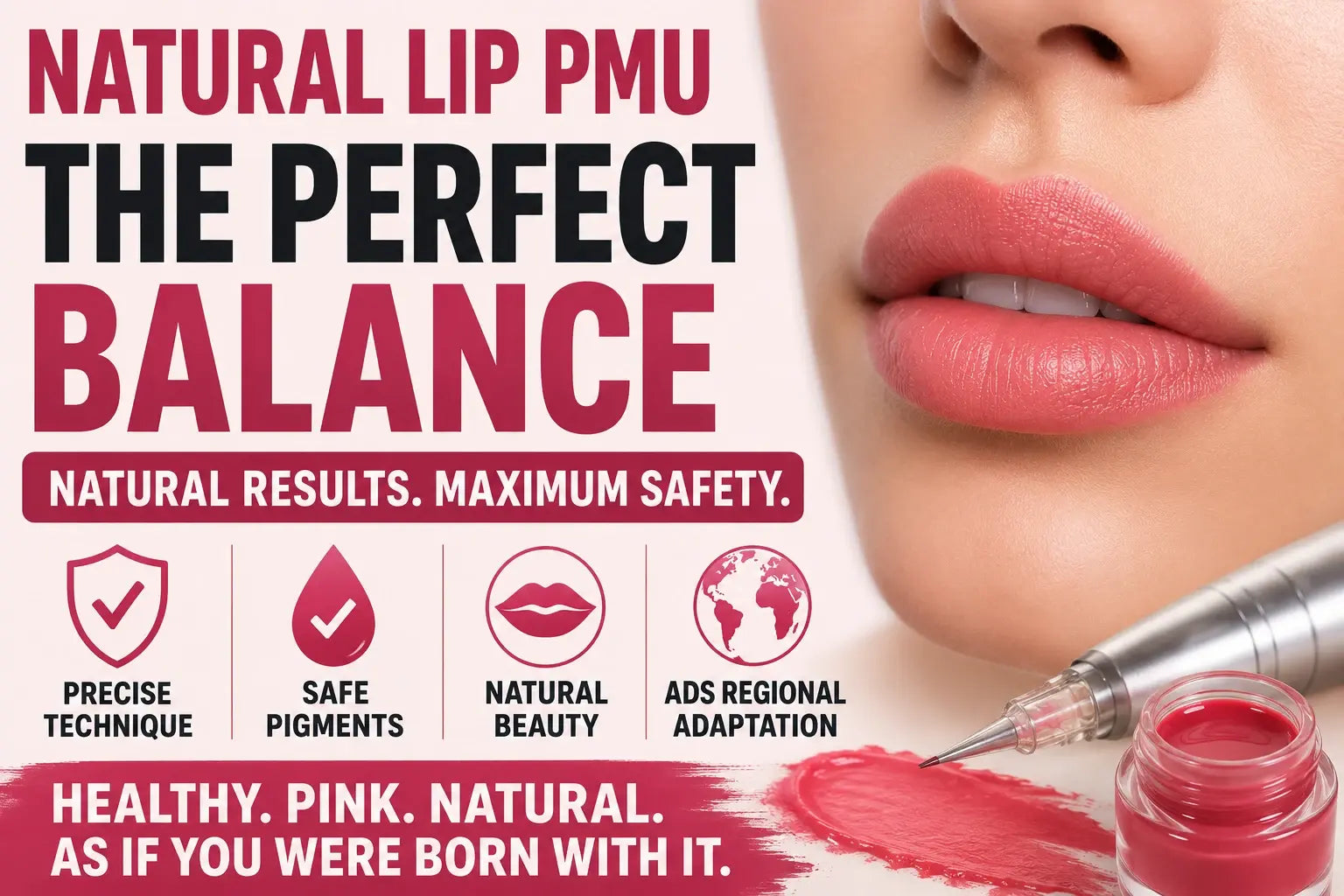
The "Mother's Natural Lip" trend — in Chinese industry terminology — has become the defining growth category in PMU lip procedures over the past two years. Its defining characteristic: the result must look as if no procedure was performed. The client wants to appear to have naturally healthy, pink, well-defined lips without any visible sign that cosmetic intervention occurred.
This is a significantly different aesthetic goal from the high-saturation lip procedures that dominated the market a decade ago. Those procedures were about transformation — visible change that communicated "I had work done." The natural lip trend is about concealment — subtle enhancement that communicates "I just look well-rested and healthy."
Meeting this goal requires meeting two simultaneous demands: the technique must be precise enough to produce natural results and the pigment must be safe enough for the most sensitive zone on the face. This combination makes natural lip PMU both the highest-opportunity and highest-risk procedure in the current PMU market. This article provides the professional framework for evaluating whether and how to add this procedure to your practice.
The Market Driver Analysis: Why This Trend Is Structurally Permanent
The Demographic That Determines Market Direction
Natural lip PMU's primary demographic is professional women aged 25–40 — a group that has driven the most significant market shifts in beauty and cosmetics over the past decade. Their defining characteristic in the context of PMU: they want results, not procedures. The procedure itself is not the product — the result is the product. They don't want to look like they had lip PMU; they want to look like they naturally have healthy, pink, defined lips.
This demographic is the fastest-growing segment in medical aesthetics globally — and their preferences are reshaping every category they touch. In PMU, this translates to: high standards for natural-looking results, high sensitivity to safety, high willingness to pay for quality, and high expectation of professional expertise from the artist.
Three structural factors ensure this trend is permanent, not cyclical:
1. Social media environment has reset aesthetic standards. The constant exposure to filtered and edited images has created a counter-reaction: the "no-filter" aesthetic that values visible authenticity over dramatic transformation. The natural lip is the physical expression of this counter-reaction.
2. Professional environments favor subtle enhancement. For women in client-facing professional roles, looking "done" can be a liability — it can undermine the perception of competence in contexts where youthfulness and vitality are valued but obvious cosmetic intervention is not. Natural lip PMU provides the vitality improvement without the professional risk.
3. The technology has caught up with the aesthetic. Five years ago, natural-looking lip PMU was difficult to achieve consistently — the pigments, machines, and techniques weren't refined enough to produce results that looked truly natural on most clients. The technical requirements of the natural lip trend (precision depth control, stable nano-scale pigment, proper pigment selection for each undertone) have now been addressed by professional-grade equipment and formulations. When the aesthetic demand met the technical capability, the market took off.
The Safety Sensitivity Premium: Why Natural Lip Demands More from Pigment Than Any Other Zone
Lip tissue has fundamentally different physiological characteristics from facial skin — and these differences create higher safety demands that most professionals underestimate:
- Minimal stratum corneum: The lip's protective outer skin layer is dramatically thinner than the rest of the face — essentially no meaningful barrier function against. What would be safely blocked by the stratum corneum on the brow reaches the dermal layer directly on the lip.
- Mucosal tissue structure: The lip's inner surface is mucosa — a different tissue type with different absorption characteristics than skin. The vascular network beneath mucosa is more exposed, which means any harmful substance in the pigment has faster access to the bloodstream.
- High vascular density: The lip's blood supply is significantly higher than the surrounding facial skin — which means the absorption and distribution of any problematic ingredient is faster and more extensive than in other zones.
These physiological facts mean that a pigment formulation that's perfectly safe for brow and eyeliner work may be problematic for lip work — not because the formulation is bad, but because the lip's tissue environment demands a higher safety standard. Professional natural lip PMU requires lip-specific pigment formulations — not general-purpose pigments used in the lip zone.
The Four-Pillar Pigment Safety Framework for Natural Lip PMU
Pillar 1: Raw Material Traceability — Knowing What's In the Bottle
The foundation of lip pigment safety is knowing the complete ingredient profile of every pigment you use in the lip zone. For professional-grade lip pigments, this means:
- Full ingredient declaration: Every component must be documented — not just the primary colorants but also the emulsifiers, preservatives, stabilizers, and any other additive. No "proprietary blends" or undisclosed components.
- Third-party heavy metal testing: Heavy metals (lead, cadmium, mercury, arsenic) that might be acceptable at trace levels in brow pigments may not be acceptable in lip pigments due to the higher absorption rate in mucosal tissue. Lip-specific testing standards should be more stringent than general PMU standards.
- Microbial specification: Lip pigments must meet the most stringent microbial limits in the PMU category — because the lip is directly into a high-vascularity mucosal surface, not just into skin. The tolerance for microbial contamination is effectively zero.
If your supplier can't provide batch-specific testing documentation for their lip pigments — including microbial results, heavy metal screening, and pigment concentration data — that's a safety gap that shouldn't exist in professional lip PMU practice.
Pillar 2: GMP Production Environment — How the Manufacturing Conditions Protect the Final Product
GMP (Good Manufacturing Practice) certification for lip pigment production means the manufacturing environment is controlled to prevent microbial contamination throughout the production process — from raw material handling through filling and packaging. Key GMP requirements for lip pigment:
- Clean room production environment: Manufacturing in a controlled environment with documented air quality, surface sanitation, and personnel hygiene standards — not standard cosmetic production conditions.
- 100% sterilization coverage: Every bottle, not statistical sampling. The same quality principle applies here as in all professional PMU pigment — "sample sterilization" is not acceptable for an implanted mucosal product.
- Validated production process: The manufacturing process must be documented and validated — meaning the production parameters (temperature, mixing speed, filling precision) are controlled and documented to ensure every batch is produced under the same conditions.
Ask your supplier for their GMP certification scope and the specific sterilization coverage documentation for the lip products you're using. If the answer is "sample sterilization" or "we follow standard cosmetic manufacturing guidelines," that's not the standard professional natural lip PMU requires.
Pillar 3: Batch Stability Verification — Why Consistency Is a Safety Issue in the Lip Zone
Batch stability is a safety issue for natural lip PMU — not just a performance issue — because inconsistent pigment behavior in the lip zone can produce unexpected color results that require correction procedures. Correction procedures mean additional trauma to an already sensitive zone, additional healing time, and additional exposure to whatever risk the pigment carries.
The specific batch stability characteristics that matter for lip pigments:
- Color consistency (ΔE control): Each batch should fall within ΔE < 1.0 from the standard reference. For lip work, this is more critical than for brow work — even small color variations that might be acceptable in a brow might produce obviously wrong results in a lip, where the color is the entire point of the procedure.
- Viscosity consistency: The pigment's flow characteristics affect how it spreads in the lip tissue — inconsistent viscosity between batches affects the artist's technique calibration and can cause over- or under-saturation in specific areas.
- Physical stability after opening: Lip pigments are often used across multiple sessions — the formulation must remain physically stable for the full declared shelf life after opening, without phase separation, viscosity change, or color shift.
Pillar 4: Regional Regulatory Compliance — Different Markets, Different Rules
Lip pigment compliance requirements vary by market — what satisfies EU requirements may not meet US FDA standards, and Chinese NMPA requirements have their own specific formulation restrictions. For professional practice, understanding which standards apply to the pigments you're using is part of the safety framework:
- EU market (REACH/ResAP): Strict limits on aromatic amines, specific colorant purity requirements, documented skin sensitization testing
- US market (FDA): Ingredient declaration compliance, facility registration, documented quality controls
- Chinese market (NMPA): Specific prohibited and restricted ingredient lists that differ from EU and US requirements
A professional supplier should be able to tell you which markets their lip pigments are compliant with and provide the relevant documentation — not just a general "we have all certifications" claim but specific certification documentation for the specific products you're purchasing.
The ADS Regional Adaptation Framework for Natural Lip PMU
Why "One Natural Pink" Cannot Work Globally
The natural lip aesthetic is defined by the concept of "improved but invisible" — the lips should look healthier, pinker, and more defined but the improvement should not be obviously attributable to a cosmetic procedure. The color that achieves this on one client will produce a dramatically wrong result on another, purely due to the difference in their skin undertone and depth.
The "natural pink" pigment that reads as perfect on a light cool undertone client will appear as a muted grey-pink on a deep warm undertone client — because the warm undertone in the skin shifts the apparent color toward orange, and the depth of the skin mutes the saturation. The result is lips that look worse than before — less healthy, not more.
ADS-calibrated lip color systems address this by providing naturally lip color families calibrated for different regional demographic characteristics:
- European cool-pink calibration: Soft cool pinks and rose tones calibrated for the pink undertone in Northern European skin — the goal is to complement the natural pink without competing with it
- North American warm-neutral calibration: Warm coral and peach tones calibrated for the broader undertone range in North American populations — more versatile but still requiring undertone matching
- Southeast Asian warm-neutral calibration: Warm coral and orange-pink tones calibrated for the characteristic yellow undertone in Southeast Asian skin — these avoid the ashy effect that cool-toned lip colors produce on warm undertone skin
- Middle Eastern warm-red calibration: Deep warm reds and berries calibrated for the rich warm undertone in Middle Eastern populations — these provide visible enhancement without appearing disconnected from the deeper skin tone
The practical implication: a professional natural lip practice needs a lip color inventory calibrated for the demographic range it serves. A practice serving exclusively Northern European clients can operate with a narrower lip palette; a practice serving a diverse demographic requires a broader ADS-calibrated lip inventory.
Pre-Procedure Assessment: The Non-Negotiable Evaluation Steps
The Four Conditions That Require Assessment Before Natural Lip PMU
1. Active lip inflammation or skin condition: Active cheilitis, angular cheilitis, cold sores (herpes simplex), or any other active lip inflammation must be treated and healed before PMU lip procedure. Implanting pigment into inflamed lip tissue risks spreading the inflammation and compromising the result. Document the assessment and advise the client accordingly.
2. Previous lip PMU history: Clients who have had previous lip PMU procedures may have residual pigment in the lip tissue that will affect the new procedure's color behavior. Assess the existing pigment: is it still visible? What undertone has it shifted to? Is neutralization required before the new procedure? This assessment is not optional — failing to identify residual pigment can produce unexpected results that are difficult to correct.
3. Skin and lip sensitivity history: Clients with a history of skin sensitivities, allergies, or autoimmune conditions require additional evaluation. Professional practice protocols should include a discussion of any known sensitivities and a consideration of whether a patch test is clinically indicated before the full procedure.
4. Medication and supplement effects: Some medications and supplements affect blood clotting, skin sensitivity, and healing — including blood thinners, retinoids, and immunosuppressants. Document the client's current medication profile and advise accordingly on whether the procedure should proceed, be modified, or be deferred.
The Assessment Documentation Standard
Every natural lip PMU procedure should begin with documented assessment — not as bureaucratic overhead but as the professional standard of care that protects both the client and the artist. The documentation should include:
- Lip skin condition assessment (normal / inflamed / scarred / previously treated)
- Previous PMU history (none / yes — documented color and approximate age of procedure)
- Sensitivity and allergy history (documented discussion, not just "none reported")
- Current medications and supplements (documented)
- Client informed consent (procedure description, expected outcomes, limitations, aftercare requirements)
Aftercare and Healing: The Professional Standard of Care
Why Aftercare Compliance Is More Critical for Natural Lip PMU Than for Any Other Procedure
Natural lip PMU requires more specific aftercare compliance than brow or eyeliner procedures, for two reasons:
1. The lip tissue heals differently. Lip tissue has a higher turnover rate and a different healing mechanism than facial skin. The healing phases are faster but also more sensitive to disruption — which means the aftercare window is both shorter and more critical than for other PMU zones.
2. The aesthetic standard is unforgiving. In natural lip PMU, any healing irregularity — a scab that's been pulled off prematurely, an infection that's introduced bacterial contamination, a healing response that's triggered excessive inflammation — will produce a visible irregularity in the final result. The "natural" aesthetic leaves no room for the kind of minor healing imperfections that might be invisible in a higher-saturation lip result.
The Professional Aftercare Protocol
Standard natural lip PMU aftercare:
- First 24 hours: No water contact with the lip area. No lip products, balms, or cosmetics. Avoid food and drink that would require lip contact — use a straw for all beverages.
- Days 1–7: No lip products containing fragrance, essential oils, or active exfoliating ingredients (salicylic acid, retinoids, AHAs). Let any scabs that form fall off naturally — no picking or peeling. Avoid extreme heat (saunas, steam rooms) and strenuous exercise that produces significant perspiration.
- Days 7–14: Continue avoiding irritating lip products. Begin using a gentle, fragrance-free moisturizing lip balm if healing is proceeding normally. Avoid sun exposure to the lip area — UV can affect the final color during the healing window.
- After 4 weeks: The final color result is typically established by week 4. If the result is lighter than expected at this point, a touch-up procedure can be scheduled — but the touch-up decision should be made only after the 4-week mark, not before.
FAQ
My client had a previous lip PMU procedure that went grey — she wants a natural pink result now. Can I work over the old pigment?
It depends on the condition of the old pigment. If the grey is significant and the previous pigment is still visibly present, attempting to work over it with a new color typically produces a muddy result — the old color shows through the new color, changing its apparent tone. In most cases where a previous lip PMU has gone grey or purple (usually from incorrect depth or an iron-oxide pigment that oxidized), the correct professional approach is to: (1) assess whether the previous pigment can be lightened with a neutralization technique, (2) if not, discuss saline or laser removal of the old pigment before applying the new color, (3) only proceed with new natural lip PMU once the base is clean enough for the new color to show correctly. Working over problematic old pigment without addressing it first is the most common cause of unsatisfactory correction results.
My client has a cold sore history — should I refuse to perform natural lip PMU?
Not necessarily refuse — but take precautions. Clients with recurrent cold sore (herpes simplex) history should be advised to use antiviral prophylaxis (e.g., valacyclovir) starting the day before the procedure and continuing for several days after, per their physician's recommendation. This significantly reduces the risk of a herpes outbreak triggered by the lip trauma. If the client has an active outbreak at the time of the procedure, it must be deferred — performing PMU on lips with active herpes risks spreading the infection and compromising the result. The protocol: history discussion in pre-assessment, antiviral prophylaxis recommendation for clients with known history, procedure deferral for active outbreaks.
Why does the same natural pink pigment look different on different clients?
Because the color in the bottle is not the color on the lip — it's the color in the bottle filtered through the client's skin undertone and lip tissue characteristics. A cool-toned natural pink on a cool undertone lip will look clean and natural; on a warm undertone lip it will appear slightly orange (the warm undertone in the skin adds warmth to the already warm pigment). This is why professional natural lip work requires an ADS-calibrated color system with undertone families — the artist selects the color based on what will produce the target result on the specific client's skin, not based on what the color looks like in the bottle or on a swatch card.
How do I advise clients who want natural lip PMU but have very dark lip pigmentation?
Very dark natural lip pigmentation is one of the most challenging conditions in PMU lip work — the darker the natural lip, the more difficult it is to achieve a visible natural enhancement result without looking unnatural. The professional assessment should determine: (1) whether the lip's dark color is primarily melanin-based (ethnic hyperpigmentation) or vascular-based (blue-purple from poor circulation), as these require different approaches; (2) whether the target result is achievable with pigment alone or whether a multi-stage approach (possible IPL or laser pre-treatment for severe cases) should be discussed. For very dark lips, the honest professional advice may be that complete "natural lip" correction to a light pink result may not be achievable safely in one or two sessions — a gradual approach or a modified target may be the responsible recommendation.
What makes lip-specific pigment different from general PMU pigment?
Lip-specific pigments are formulated for the specific physiological environment of lip tissue: higher safety standards for mucosal absorption, adjusted pH for the lip's tissue chemistry, and color calibration specifically for the vascular-rich pink environment of the lip. General PMU pigments may be safe for brow and eyeliner but not optimized for lip work. The key differences: stricter microbial limits (lip tissue's vascularity means any contamination has faster systemic access), pH calibrated for mucosal tissue (not standard skin pH), and undertone families specifically calibrated for how lip colors appear against different skin undertones. Using general PMU pigment in the lip zone is a compromise that professional natural lip practice should avoid — the safety margin is narrower and the result quality is harder to predict.
Key Takeaways
- The natural lip PMU trend is structurally permanent — driven by demographic shifts (professional women aged 25–40 who want natural-looking results without obvious cosmetic intervention), social media aesthetic reset, and technical capability that now matches the aesthetic demand
- Lip tissue's physiological characteristics (minimal stratum corneum, mucosal structure, high vascular density) create higher safety demands than any other PMU zone — general-purpose pigments are not adequate for professional lip work
- The four-pillar pigment safety framework for natural lip PMU (raw material traceability, GMP production environment, batch stability verification, regional regulatory compliance) must be met for every lip pigment in your inventory
- ADS regional adaptation is not optional for professional lip work — a "natural pink" that reads perfectly on a cool undertone lip will look wrong on a warm undertone lip, and the only solution is an ADS-calibrated undertone family system
- Pre-procedure assessment is non-negotiable — active inflammation, previous PMU history, sensitivity history, and medication profile must all be documented before proceeding
- Aftercare compliance is more critical for natural lip PMU than for other procedures because the aesthetic standard is unforgiving — minor healing irregularities that would be invisible in high-saturation lip work are visible in natural lip results
- The cold sore prophylaxis protocol (antiviral medication before and after procedure for clients with known history) is the professional standard of care — not optional, not exceptional, just standard practice
