




How PMU Portfolios Should Evolve Between Years One, Three and Five

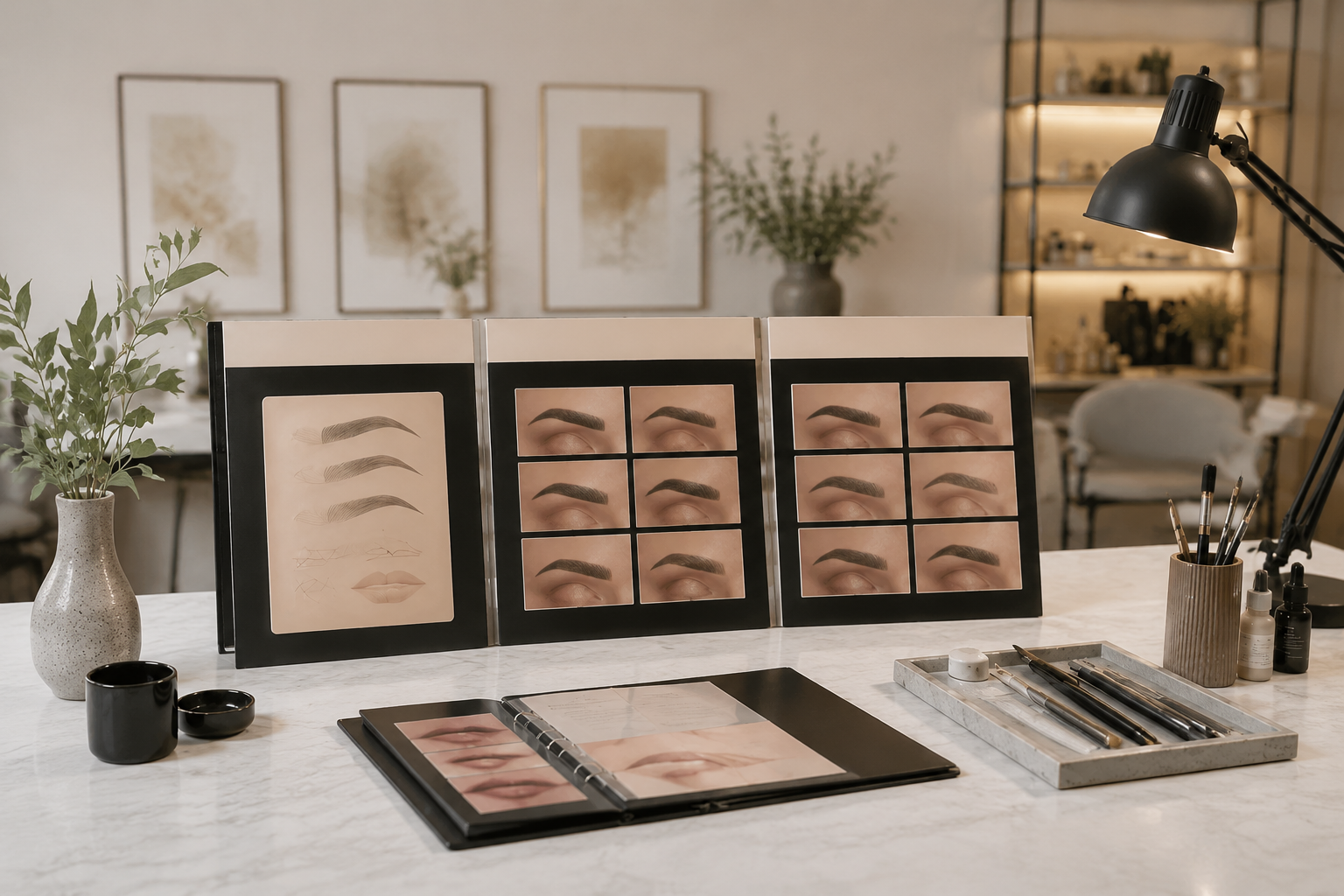
Build a portfolio that reflects the work you can competently deliver now, then gradually replace volume with better-documented healed outcomes, clearer service positioning, and an organized case archive. At every stage, label the treatment and image timing accurately. An immediate post-procedure image is useful documentation, but it is not proof of a final result.
A strong PMU portfolio is not simply a gallery of flattering images. It is a practical record of your current work, your developing style, and the types of clients and services you are prepared to represent publicly.
Set One Publishing Standard Before Building More Volume

Use the same basic publishing standard for every case, whether it is a training model, paid appointment, touch-up, correction, or annual refresh.
Before publishing, confirm that the case has:
- A retrievable permission record for the agreed use of images
- A clear service label, such as powder brows, lip blush, eyeliner, SMP, or scar camouflage
- An accurate case-status label: training model, discounted appointment, paid client, correction, work over existing PMU, or touch-up
- Image timing identified as before, immediately after, healed, touch-up, or longer-term follow-up
- A treatment-focused image with the brows, lips, liner, or other treated area as the visual priority
- A clean, neutral, uncluttered background
- Restrained editing only, such as modest brightness, contrast, sharpness, or rotation adjustments
Consistent lighting makes comparisons more useful. Daylight-balanced lighting around 5600 K with a CRI of 90 or higher is commonly used to better show skin and pigment color; indirect natural window light can be a practical alternative when dedicated lighting is unavailable. Neither approach guarantees color accuracy across cameras, screens, or viewing conditions, but consistency gives your own case library a more reliable visual baseline.
Avoid heavy filters, makeup that obscures the treated area, selective angles that hide the result, or edits that make the work look artificial. If you publish on Google Maps, its media guidance permits minimal adjustments such as lighting improvements or rotation correction, while cautioning against heavy filters that prevent an accurate depiction.
Year One: Build an Honest Baseline, Not a High-Volume Showcase
In the first year, your portfolio should establish what you can do now---not create the impression that you have years of healed-case experience.
A Year One portfolio can include training models, discounted appointments, and paid clients. The important distinction is transparency. A model case is not less valuable simply because it was completed during training or at a reduced price; it becomes misleading only when its context is hidden or it is used to imply a level of experience you have not yet built.
Publish Cases That Represent Your Current Practice
Keep and publish cases that:
- Show work you are comfortable consulting for and performing within your current scope
- Are photographed clearly and labeled accurately
- Represent the services you currently want to offer
- Include healed documentation when it is available
- Help clients understand your present style rather than an aspirational one
Hold back, archive, or limit promotion of cases that:
- Were completed in a service you are still developing
- Have unclear image timing or missing case details
- Depend entirely on immediate-after photos
- Do not reflect the quality, style, or consultation fit you want to represent now
- Cannot be tied to a usable permission record
Think of this stage as a baseline portfolio. It should show growth, but it should not require you to market every service equally. A smaller, accurately labeled collection is more useful than a large gallery that blurs the difference between training work, paid work, and healed outcomes.
Document Each Case as a Sequence
A mature portfolio is built from repeatable case documentation, not occasional social posts. For each consented client, create an internal sequence:
- Before: Capture the untreated area in your standard lighting and angle.
- Immediately After: Document the fresh result, clearly labeled as post-procedure.
- Healed: Photograph the result at the actual follow-up interval available for that client.
- Touch-Up: If performed, identify it as a touch-up rather than presenting it as an initial procedure.
- Longer-Term Follow-Up: When available and consented, archive it as retention documentation rather than as a promise of identical results for future clients.
Captions should do real work. For example:
Powder brows --- healed image photographed four weeks after the initial session; touch-up completed.
"Four weeks" in that caption identifies when the image was taken. It does not mean every client reaches the same healing stage or outcome at that interval. Use the actual timing for each case rather than copying a standard phrase.
Year Three: Let Healed Evidence Shape Your Specialty
By Year Three, the portfolio should begin shifting from a learning record toward a positioning tool. You may still offer more than one service, but your public gallery should lead with the work for which you have the clearest, most consistent documentation.
Review your cases by service, not just by how visually striking they appear. Ask:
- Which services have the strongest healed-image record?
- Which types of cases can you explain clearly during consultation?
- Which work best represents your current style?
- Where do you have enough before, fresh, healed, and touch-up documentation to show a complete case story?
- Which services still rely mostly on immediate-after images?
If your healed records are uneven across brows, lips, eyeliner, SMP, or corrective work, keep the public portfolio broader but restrained. If one category has a stronger archive of clearly documented, representative outcomes, let that service lead your website, booking pages, and social highlights.
Specialization should follow your own case record and consultation confidence---not a trend or a single popular post.
Make Case Categories Easy to Read
At this stage, organize work so prospective clients can distinguish between:
- Initial procedures
- Healed results
- Touch-ups
- Annual refreshes
- Corrections
- Cover-ups or work over previous PMU
- Training-model cases, where relevant
Do not group correction or cover-up work with standard initial procedures without context. These cases may be valuable evidence of your developing range, but they should never imply that every prior PMU result can be corrected, covered, or transformed in the same way.
Year Five: Curate a Case Library That Can Withstand Questions
A five-year portfolio should feel more selective, not merely larger. The public gallery becomes a curated representation of your strongest and most relevant work, while a private case library supports it with dates, treatment status, original files, permissions, and notes.
The difference matters. Attractive social-media images can create interest; an organized case library helps you answer reasonable client questions about what they are seeing.
Your public portfolio should prioritize:
- Representative healed work in your primary services
- Clear examples of your current style
- Cases with complete labels and image timing
- A balanced selection rather than only unusually photogenic results
- Carefully contextualized correction, cover-up, and previous-work cases
- Current work that still reflects your standards and service menu
Archive or remove public images that are outdated, inconsistently photographed, heavily edited, no longer representative of your work, or missing usable permission documentation.
At five years, you do not need to prove every procedure you have ever performed. You need to make it easy for an appropriate client to understand the work you do now.
Run a 90-Day Portfolio Audit
The strongest five-year portfolio is built case by case, beginning with honest Year One documentation.
Over the next 90 days:
- Audit your existing gallery. Categorize every public image by service, date, image stage, case type, consent status, and current relevance.
- Remove ambiguity. Update captions that do not distinguish fresh work from healed work, touch-ups, corrections, or model cases.
- Create a capture routine. Use one lighting setup, one background approach, and repeatable before-and-after angles.
- Prioritize healed follow-ups. Build your next set of content around properly consented healed cases rather than another collection of immediate-after images.
- Review your service emphasis. Lead with the work your documented case record supports today.
As your studio grows, use related BIOMASER PMU Career & Studio Business resources to refine consent workflows, studio systems, education planning, and verified equipment or supply research for your own practice.
