









Documenting Contraindications So Everyone Signs the Same Story

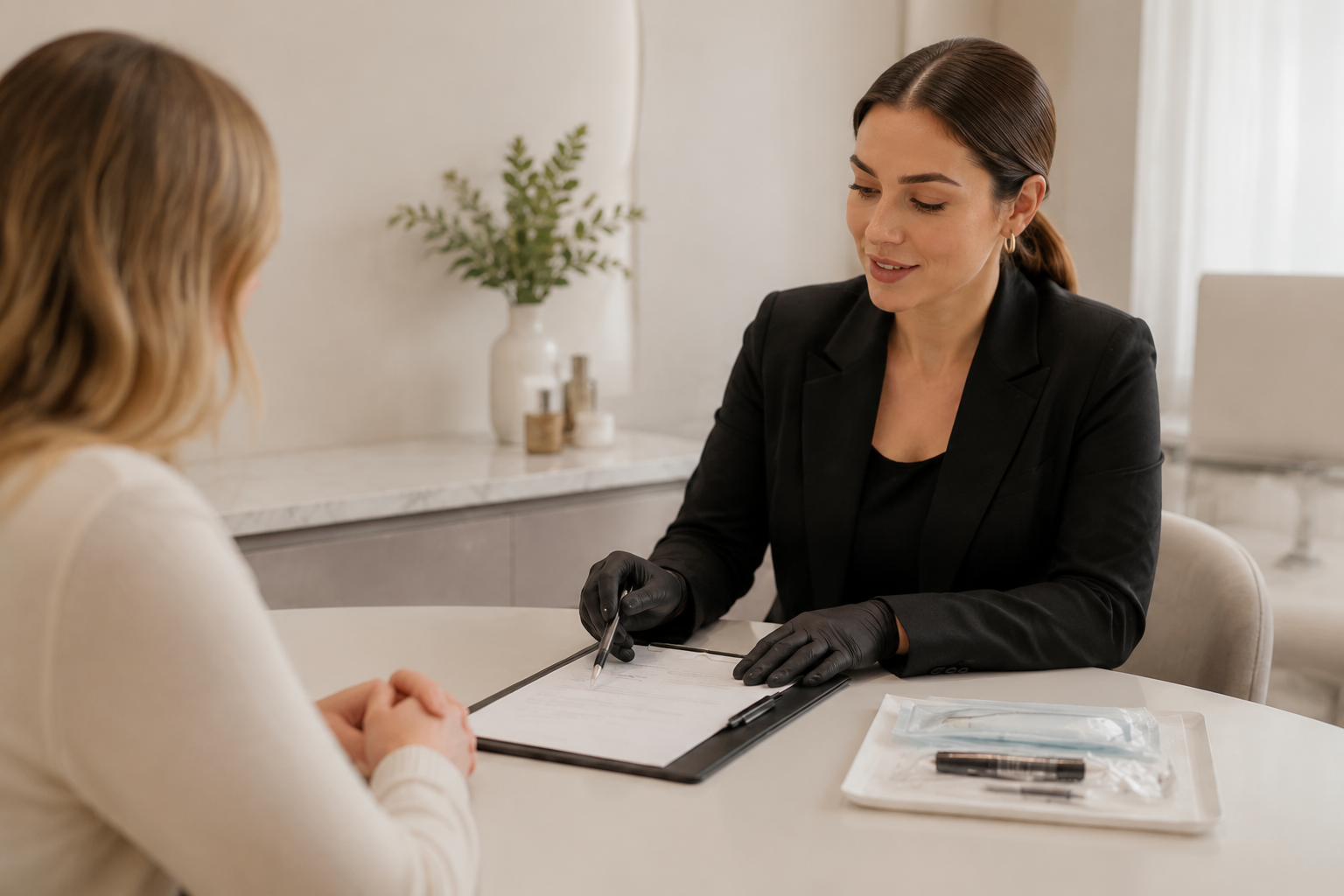
Use one version-controlled pre-procedure packet that links five distinct records: the client's disclosures, the artist's observations, the studio's proceed/defer/decline decision, the client's acknowledgment of that decision, and the procedure-specific aftercare record. Recheck the packet on appointment day, document any changed answer without overwriting the original, and keep optional marketing permission separate from treatment paperwork.
The goal is not to create a stack of waivers. It is to create one accurate, chronological account of what was disclosed, what was reviewed, what decision the studio made, and what the client received.
Build One Decision Record, Not a Stack of Conflicting Forms

A PMU consultation can become difficult to reconstruct when health questions, verbal disclosures, procedure consent, aftercare, and artist notes live in separate places. A better approach is one packet with clearly separated components and a shared client identifier, date, and version number.
Your packet can include:
-
Client disclosure form Record the health, medication, treatment, allergy, and skin-history questions your studio policy and local requirements call for. The client answers in their own words where clarification is needed.
-
Artist review and observation notes Record what the client reported and what you can directly observe at the intended treatment site. Avoid diagnoses, predictions, or medical conclusions.
-
Treatment-decision record Use a clear outcome field:
- Proceed
- Proceed with a documented modification
- Defer or reschedule
- Decline service
- Request client-provided medical information or clearance under studio policy
- Include the reason in neutral, factual language: "Client reported a change since consultation," "Visible irritation observed at intended site," or "Client declined to complete the required intake item."
-
Procedure consent This should acknowledge the actual service planned, not a generic service description that no longer matches the appointment.
-
Aftercare record Attach or identify the written aftercare provided for that procedure. A Los Angeles County permanent-cosmetics infection-control template, for example, calls for clients to receive written postprocedure recommendations and care information; it also requires its infection-control plan to be maintained and updated when procedures or technology change. See the Los Angeles County infection-control plan template for that limited local example.
Keep the components distinct even if they are delivered through one digital form. A client's disclosure is not the same as the artist's assessment, and treatment consent is not proof that an earlier answer remains accurate.
Use a Non-Diagnostic Decision Path
A contraindication policy should give every artist the same operational choices without asking the artist to practice medicine.
When a client reports a condition, medication, recent treatment, allergy history, skin concern, or other factor covered by your policy, the artist's job is to document the report, apply the studio's decision path, and stay within their scope.
A useful internal sequence is:
- Record the disclosure exactly enough to understand the issue.
- Record relevant visible observations without naming a diagnosis.
- Apply the studio policy and applicable local rules.
- Choose and document the appointment outcome.
- Obtain acknowledgment of the final decision and revised plan, if any.
For example, do not write, "Client is medically cleared" or "Skin condition is safe for PMU." Instead, write what happened:
Client reported a new health-related concern since the original intake. Artist reviewed studio policy and deferred the procedure. No service was performed. Client received the rescheduling decision and acknowledged the updated record.
If your policy permits a client to provide information from a clinician, document what the client supplied, the date received, and the studio's final decision. Client-provided information does not replace the studio's own scope limits, local requirements, or authority to decline a procedure.
Make Appointment-Day Changes Create a New Signed Trail
The day-of review is where a consistent packet either holds together or breaks down.
Ask the client to confirm whether anything has changed since the consultation. If an answer changes, do not erase the original response or quietly replace the previous form. Preserve the original answer and add a dated amendment.
Use a Simple Amendment Block
A practical amendment can include:
- Original intake date
- Item or section changed
- Client's updated statement
- Artist's factual note
- Final service decision
- Any modification to the planned procedure
- Client initials or signature
- Artist initials or signature
- Date and time
For example:
Since the original intake, client updated response to item ____. Artist reviewed the updated disclosure. Decision: defer service. Original answer remains part of the record. No procedure performed.
If the service proceeds with a changed plan, make every affected document match the final service. Update the consent description, procedure notes, aftercare selection, and any required traceability information. In the cited county template, permanent-cosmetics equipment documentation includes the machine name, manufacturer, and model number; local authorities may require additional procedure records.
A changed answer is not automatically a reason to proceed or decline. It is a reason to pause, document, and make the studio's decision visible.
Separate Treatment Consent From Marketing Permission
A procedure consent concerns the client's treatment decision. A photo release, testimonial permission, social-media permission, or portfolio authorization concerns optional marketing use. Do not combine them in a way that suggests a client must approve publication to receive service.
Use a separate marketing-permission choice with plain-language options, such as:
- I permit use of identified images.
- I permit use of cropped or non-identifying images only.
- I do not permit marketing use.
Keep the choice separate from the health intake, procedure consent, and aftercare acknowledgment. If permission changes later, record the change through a dated correction process rather than altering the original signed record.
Store the Packet as Sensitive Business Records
Health disclosures, identification, photographs, signed forms, and procedure notes deserve controlled handling even when the studio's HIPAA status is not established.
HIPAA applies to covered entities and business associates, not automatically to every business that collects health-related information. A provider becomes a HIPAA covered entity only under specific conditions involving electronic transmission for certain standard transactions; collecting PMU intake information alone does not determine coverage. Review the HHS covered-entity guidance against your studio's actual operations.
Set a written studio process for:
- Role-based access to client records
- Secure storage of paper and digital forms
- Version control for revised documents
- A visible audit trail for corrections and signatures
- Separation of treatment records from optional marketing permissions
- Procedures for staff access, correction requests, and record retrieval
- Verification of retention requirements with the local body-art authority, licensing rules, insurer, and applicable privacy obligations
Do not use narrow infection-control retention periods as a substitute for client-record retention rules. Recordkeeping requirements can differ by jurisdiction, licensing category, insurer terms, record type, and operating model.
Train the Team on the Same Script
A strong form cannot fix an inconsistent staff response. Every artist, receptionist, and studio manager should know what to say when a client changes an answer, refuses to sign, requests a modification, or arrives with information that affects the planned service.
Train staff to use neutral language:
- "I'll document your update and have the artist review the appointment plan."
- "We need the final record to match today's service."
- "We cannot remove the original answer, but we can add your updated statement."
- "Marketing permission is optional and separate from your procedure paperwork."
Audit the packet whenever your studio changes procedures, equipment, digital-form tools, or escalation rules. The finished file should read as a shared safety record---not a defensive pile of signatures. Every disclosure, artist decision, acknowledgment, procedure note, and aftercare record should tell the same accurate story.
Legal Disclaimer
This article is provided for general informational and educational purposes only and does not constitute legal, tax, insurance, regulatory, or professional advice. Requirements may vary by jurisdiction and change over time. Consult a qualified local attorney, licensed insurance professional, accountant, or relevant regulator for advice tailored to your studio and circumstances.
