







PMU Pigment Safety Assessment: Six-Layer QC from Raw Material Traceability to Batch Sterilization

Introduction
Ask a PMU artist what she does to ensure pigment safety, and the most common answer is: "I check the certification." The assumption is that if a product has CE marking or FDA registration, the safety question is answered.
The assumption is understandable but wrong. A certification document answers the question: "Does this product meet the standard at the time of testing?" A quality control system answers the question: "Does every single batch of this product consistently meet the standard, every time it ships?" The gap between these two answers is where client safety incidents happen — and it's wider than most artists realize.
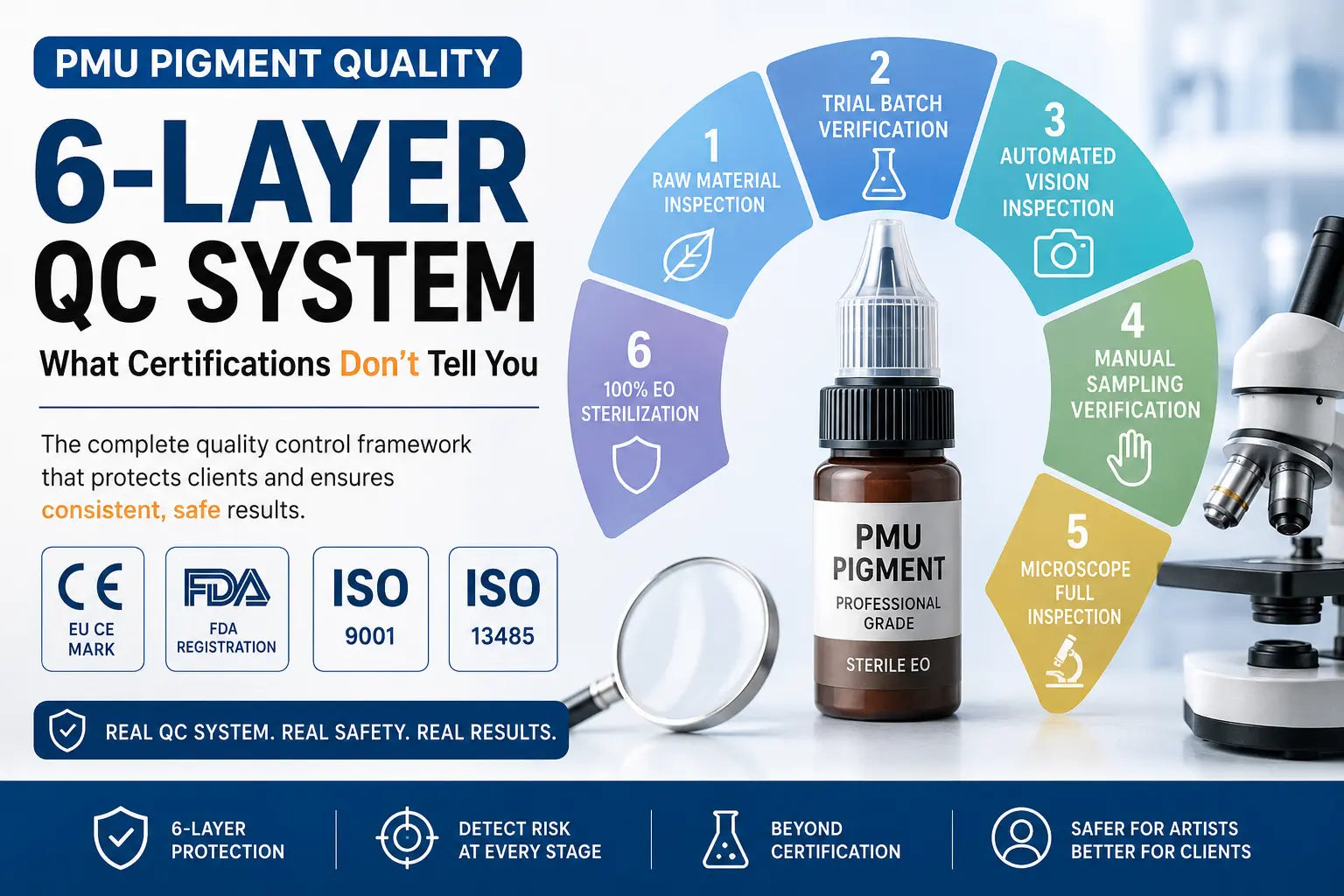
This article breaks down the complete six-layer QC system that a professional-grade pigment manufacturer should have operating continuously — not as a marketing claim, but as a documented, auditable quality infrastructure. Understanding this system is the difference between selecting pigments based on incomplete information and making a genuinely informed procurement decision.
The Core Problem: Why "Has Certification" Is Not the Same as "Has a QC System"
Certification Answers One Question; A QC System Answers Many
A CE mark or FDA registration is typically based on testing of a specific product formulation — often tested once, or at most a small number of times, when the product was first submitted for certification. The test results confirm that the formulation as submitted met the safety thresholds at the time of testing.
What the certification does not confirm:
- That every batch of raw material used in production has the same composition as the batch that was tested
- That the manufacturing process is operating consistently batch after batch
- That the sterilization process covers every bottle, not just a statistical sample
- That the quality control checkpoints are actually being performed on every production run
The distinction between "has certification" and "has a QC system" is the distinction between a photograph and a continuous video. One confirms a moment; the other confirms ongoing behavior.
Where the Quality Gaps Actually Are
The specific failure points in pigment quality that certifications don't systematically address:
Raw material batch variation: Pigment raw materials — mineral oxide colorants, plant extracts, emulsifiers — have natural variation between batches in and . If incoming raw materials aren't tested before each production run, a substandard batch can enter the manufacturing process undetected, regardless of what the certification document says about the formulation.
Manufacturing process consistency: The emulsion system in PMU pigment (the oil-water structure that carries color molecules) requires precise mixing parameters. If parameters drift, the result can be pigment molecules distributed unevenly in the bottle, or phase separation (oil-water splitting) that isn't visible but affects. Without real-time process monitoring, these defects reach the finished product.
Sterilization coverage: "" (sample sterilization) — where a statistical sample from each batch is sterilized rather than every bottle — is a cost-saving practice that leaves a portion of each batch unsterilized. This is not acceptable for a product that will be implanted into human skin. 100% EO sterilization — where every bottle is sterilized — is the professional standard.
Detection scope: Heavy metal and microbial testing are necessary but not sufficient. A complete safety profile requires skin sensitization testing, cytotoxicity assessment, and photochemical stability testing — the comprehensive 19-item professional test protocol that reputable manufacturers perform but that budget products skip.
The Six-Layer QC System: What Each Layer Actually Does
Layer 1: Raw Material Incoming Inspection — The Foundation of Everything
The first control point in any real quality system is the raw material incoming inspection — checking every batch of before it enters the production process. This is where the quality system either proves itself or reveals its absence.
What a proper raw material incoming inspection covers:
- Pigment concentration verification: Using spectrophotometry to measure the color strength (Chroma Value) of each batch against the standard specification. Any batch outside the acceptable concentration range is rejected, regardless of how it looks.
- Microbial load testing: Total plate count, E. coli, Staphylococcus aureus — multiple indicator tests. Raw materials with microbial loads above the professional-grade threshold don't enter production, period.
- Heavy metal screening: Testing against EU ResAP permanent cosmetic standards, which set specific limits for lead, cadmium, mercury, arsenic, and other heavy metals. This isn't optional — it's the foundational safety verification.
The core principle of the incoming inspection layer: no unqualified raw material enters production. This sounds basic, but it's the single most important control point in the entire quality chain. If this layer isn't operating, no amount of downstream inspection can compensate for contaminated.
Layer 2: Trial Batch Verification — Validating Formulation Stability Before Mass Production
Every new pigment formulation, or any reformulation of an existing product, must go through trial production before mass production begins. Trial batches serve as the bridge between R&D and full-scale manufacturing.
Trial batch verification checks:
- Color consistency comparison: Trial samples are visually and instrumentally compared against the standard color sample — checking, , and against the design specification
- Centrifugal stability testing: High-speed centrifugation physical stress — testing for phase separation, flocculation, or oil exudation that would make the product unstable in the field
- Skin sensitization preliminary screening: Sampling from trial batches for initial skin sensitization assessment, identifying potential risks before the formulation is locked for mass production
Trial batch verification is the last line of defense before mass production locks in a potentially flawed formulation. Without this layer, R&D formulation errors reach the production line and potentially the market.
Layer 3: Automated Vision Inspection — Real-Time Defect Detection at Production Speed
Manual sampling can't keep pace with high-volume production lines. Automated vision inspection systems perform real-time imaging analysis on every bottle as it moves through the filling process.
Automated vision inspection typically covers:
- Liquid level detection: Confirming that fill volume is within the standard specification range for each bottle
- Bottle mouth cleanliness inspection: Identifying spills, cross-contamination, or foreign matter at the sealing surface
- Label integrity detection: Confirming label presence, readability, correct positioning, and absence of print defects
The critical advantage of automated vision inspection: it shifts quality control from "detect and reject after production" to "intercept in real time during production." Defective bottles are identified and removed before they become finished goods — not caught in QC and discarded as finished product waste.
Layer 4: Manual Sampling Verification — The Layer Machines Can't Replace
Automated inspection handles the quantifiable, pattern-matching dimensions of quality control. But some quality attributes require human professional judgment that no algorithm currently replicates.
Manual sampling verification covers:
- Texture and hand-feel evaluation: Professional assessment of the pigment's consistency, emulsification degree, and by touch — detecting abnormalities that imaging systems can't see
- Odor evaluation: Opening bottles to assess whether there is any abnormal odor that would indicate deterioration or microbial contamination
- Flagged unit review: Human re-inspection of any units flagged by the automated system as potentially non-conforming — making the final call on whether they need to be rejected
Manual sampling is the complement to automated inspection — handling the dimensions of quality that require professional judgment while letting machines handle the high-volume, pattern-based inspection tasks they're better suited for.
Layer 5: Microscope Full Inspection — The Layer That Catches What Macros Miss
Microscope inspection is where the six-layer QC system gets its most granular — examining pigment at the particle level to verify physical quality characteristics that determine how the pigment behaves in the skin.
Microscope full inspection covers:
- Particle dispersion evaluation: At 400x optical magnification, examining whether pigment particles are evenly dispersed with no significant aggregation. Poorly dispersed pigment produces uneven color blocks in the skin — a defect that isn't visible in the bottle but becomes obvious after implantation
- Particle size verification: Measuring average particle diameter to confirm it falls within the safe and effective range. Particles that are too large cause poor color release and potential foreign body reactions; particles that are too small may be metabolized too quickly, causing premature fading
- Contaminant screening: High-magnification examination for non-pigment foreign matter — particles that shouldn't be there, indicating a contamination issue in the manufacturing process
Microscope full inspection is the final checkpoint for physical quality — ensuring that at the microscopic level, each batch meets the same standard as every other batch. Without this layer, particle-level defects reach the market undetected.
Layer 6: 100% EO Sterilization — The Non-Negotiable Endpoint
Sterilization is where the quality control system meets the product's fundamental safety purpose. PMU pigment is implanted into skin — it must be free of all viable microorganisms, without exception.
The three primary sterilization methods used in the pigment industry:
- EO (Ethylene Oxide) sterilization: Penetrates packaging and bottle walls to kill all viable microorganisms including bacterial spores. Temperature is controlled to avoid affecting pigment molecular structure. Requires proper aeration/ after sterilization to remove EO. This is the professional standard for PMU pigment.
- Gamma irradiation: Effective sterilization but can affect pigment molecular structure — potentially causing color shift or degradation over time. Less preferred for PMU pigment formulations.
- Filtration sterilization: Filters out microorganisms but does not address endotoxins or heat-stable bacterial metabolites. Not sufficient alone for a product implanted into dermal tissue.
100% coverage vs. sample coverage: Some manufacturers use "sample sterilization" — testing a statistical sample from each batch and assuming the rest are sterile based on process validation. This is not acceptable for professional PMU pigment. Every bottle that will be implanted into a client must be sterilized — not a sample of the batch, not a statistical proxy. 100% EO sterilization is the professional standard that reputable manufacturers apply without exception.
The ResAP Standard: What EU Compliance Actually Requires
The Scope of EU ResAP (Resolution AP) for PMU Pigments
The EU ResAP permanent cosmetic standard is the most widely recognized regional quality benchmark for PMU pigments. It establishes specific requirements that go beyond what general cosmetic regulations cover:
- High-concern substance control: ResAP prohibits or limits specific substances that are permitted in general cosmetics but not in permanent cosmetic implants — forcing manufacturers to apply more stringent supplier evaluation for raw materials
- Colorant purity requirements: Mineral oxide pigments must meet specific purity grades — not containing other metal impurities that could cause unexpected skin reactions
- Aromatic amine control: Certain azo colorants can decompose under specific conditions to produce aromatic amines, which are known sensitizers. ResAP sets extremely strict detection limits for these substances — compliance requires eliminating them at the design stage, not detecting them in the
ResAP compliance is not a one-time certification event — it's a continuous formulation control commitment. The standard requires that the manufacturer applies ResAP-level controls to every batch of every product, not just the batch that was submitted for initial testing.
The Four-Core-Certification Matrix: What Full Compliance Looks Like
A professional-grade pigment manufacturer should hold a certification matrix that covers four distinct quality dimensions:
| Certification | Quality Dimension | What It Validates |
|---|---|---|
| FDA Registration | Product safety (US market) | Formulation compliance, labeling accuracy, facility registration |
| EU CE Mark | Product safety (EU market) | ResAP compliance, skin sensitization testing, microbial limits |
| ISO 9001 | Quality management system | Process control, documentation, traceability, corrective action procedures |
| ISO 13485 | Medical device manufacturing | Production environment, process validation, batch traceability, regulatory compliance — medical device grade |
ISO 13485 is the differentiator. This certification is designed for medical device manufacturers — it requires production environment controls, process validation, and batch traceability at a level significantly above standard cosmetic manufacturing. Only a small number of PMU pigment manufacturers globally have achieved ISO 13485 certification. When a brand holds all four certifications, they have built a quality management infrastructure that goes beyond cosmetic compliance into medical device territory.
How to Evaluate Whether a Brand's QC System Is Real
Four Questions to Ask Your Supplier
1. Can you provide batch testing reports for the specific batches I'm purchasing — not just a general product certificate?
A real quality system produces documentation for every batch. "General product certificate" confirms the formulation was tested at some point. "Batch testing report" confirms the specific bottles you're receiving were tested and met specification. If the supplier can't provide batch-specific documentation, that's a quality transparency problem.
2. Is your sterilization 100% coverage or statistical sampling?
If the answer is anything other than "100% of every bottle is sterilized before shipping," that's a safety gap. Sample sterilization leaves some percentage of each batch unsterilized — and there's no way to know which bottles in your order are the unsterilized ones.
3. What does your ISO 13485 certification cover — the facility, the product line, or a specific product model?
Scope matters. A certification that covers the entire facility and all products is significantly more meaningful than one that covers a single product line or a single product model. Ask for the certification scope and verify it with the issuing body.
4. How do you handle raw material batch variation?
If the answer involves anything other than "we test every incoming batch against spec before releasing it to production," the quality system has a gap at the most critical control point. Raw material variation is the most common source of batch-to-batch inconsistency, and it's the first thing a real QC system addresses.
Why Production Process Controls Determine Final Quality
Emulsion Stability: The Foundation of Color Consistency
PMU pigment is fundamentally an emulsion system — water-based plant extracts and oil-phase pigment carriers must be thoroughly mixed and remain stable. If the emulsification process isn't precisely controlled, the result is:
- Phase separation before use — pigment settles, bottom of the bottle is darker than top
- Uneven color distribution in the skin — clusters of concentrated pigment next to areas with insufficient color
- Changed consistency over time — opened bottles change viscosity and behavior as the emulsion breaks down
Professional manufacturers use low-speed shear emulsification combined with vacuum deaeration — the combination ensures thorough mixing, eliminates air bubbles that could affect color distribution, and produces a physically stable product that remains consistent from the first drop to the last.
Particle Size Distribution: The Parameter That Determines Everything
Pigment particle size distribution determines three critical performance characteristics:
- Color release behavior: Correctly sized particles release color predictably during implantation, producing even saturation
- Retention duration: Particles in the correct size range (approximately 0.020μm nano-scale) are small enough to be phagocytosed by fibroblasts and integrated into the dermal matrix, producing stable long-term retention
- Metabolic clearance rate: Particles that are too small are metabolized too quickly, causing premature fading. Particles that are too large trigger immune clearance, also causing fading and potential migration
These parameters need to be designed into the at the R&D stage and validated through trial batch testing — not guessed at or left to chance.
FAQ
What is the most important quality inspection layer in the six-layer QC system?
All six layers are necessary — the system is only as strong as its weakest layer. However, the raw material incoming inspection layer (Layer 1) is the most foundational because it prevents substandard raw materials from entering production in the first place. If contaminated or off-specification raw materials reach the manufacturing process, no amount of downstream inspection can fully compensate. A brand with a strong Layer 1 and weaker downstream layers will still outperform a brand that skips Layer 1 and relies on testing.
My pigment supplier says their product is "CE certified" — is that sufficient safety verification?
CE marking confirms the product passed safety testing for the specific formulation that was submitted. It does not confirm that every batch is tested, that raw materials are verified per batch, that sterilization covers every bottle, or that the manufacturing process is consistently controlled. For meaningful safety verification, look for CE marking combined with ISO 9001 (process consistency) and ideally ISO 13485 (medical device grade manufacturing standards). The certification matrix is what provides real assurance — a single certification is a starting point, not a complete answer.
How do I verify that a supplier's 100% EO sterilization claim is actually being applied to my order?
Ask for the sterilization certificate for the specific batch your order comes from — a batch sterilization certificate should show the sterilization parameters (EO concentration, exposure time, temperature, aeration duration) and confirm 100% coverage. If the supplier only provides a general sterilization validation document without batch-specific data, that's an indication that batch-specific sterilization records may not be maintained. Reputable manufacturers maintain complete sterilization records for every production batch and can provide batch-specific documentation on request.
Why do some pigments change color or become thinner after being stored for a few months?
This is typically one of two failure modes: (1) Emulsion breakdown — the oil-water emulsion that carries the pigment is physically unstable under the storage conditions, causing the formulation to separate or the viscosity to change. This is a manufacturing quality issue, not a handling issue. (2) Oxidation — pigment molecules are reacting with oxygen that penetrated the bottle seal over time, causing color shift. Professional manufacturers use airtight bottle seals and provide storage guidance (away from direct sunlight, consistent temperature) to minimize this. If a pigment changes significantly within weeks to months of purchase, the formulation's stability engineering is inadequate — worth raising with the supplier and considering a different brand for future purchases.
Is "natural" pigment safer than synthetic pigment?
Not inherently — "natural" refers to the source of the pigment, not its purity or safety profile. Plant-derived pigments can contain allergens, variable compound concentrations, and microbial contamination risks just as synthetic pigments can. What matters is not the source but the processing: has the raw material been refined to remove impurities and tested for safety? A professional-grade pigment, whether mineral or plant-derived, will have undergone the same purification, testing, and quality control. Source-based marketing ("natural," "mineral," "organic") is not a safety indicator — ask for the third-party test reports and certification documentation instead.
Key Takeaways
- A certification document confirms "this formulation passed testing at some point" — it does not confirm "every batch meets the standard every time it ships." The distinction is where safety failures happen.
- The six-layer QC system (raw material inspection, trial batch, automated vision, manual sampling, microscope inspection, 100% EO sterilization) must be operating continuously — gaps between layers are where defects reach the market
- 100% EO sterilization coverage is the professional standard — "sample sterilization" or "statistical sterilization" leaves some bottles unsterilized and is not acceptable for an implanted product
- EU ResAP compliance requires continuous formulation control, not just initial certification testing — it must be applied to every batch, not just the submitted sample
- The four-core certification matrix (FDA + CE + ISO 9001 + ISO 13485) provides the most meaningful quality assurance — ISO 13485 is the differentiator that separates medical device grade from cosmetic grade manufacturing
- Raw material batch variation is the most common source of batch inconsistency — proper incoming inspection for every batch is the foundational control point that downstream inspection cannot fully compensate for
- "Natural" or "mineral" marketing is not a safety indicator — request third-party test reports and batch documentation regardless of the source narrative
