




2026 PMU Lip Trends: Soul Color Matching and Regional Skin Tone Adaptation

Introduction
Five years ago, the PMU lip market was simpler. Bold lip colors, high saturation, clearly "done" results. The aesthetic goal was visible transformation — the client wanted people to notice she had gotten her lips done. The market rewarded boldness.
That market has changed. Today's dominant lip PMU client — typically a 25–40 year old professional woman — doesn't want visible transformation. She wants a result that looks like she just had a really good day, or just woke up looking well-rested, or has naturally good coloring. The language clients use has shifted from "I want defined lips" to "I want to look like I was born with this color."
This is the "soul color" movement in PMU lips — the idea that the best lip color is the one that looks like it belongs to the person, not like it was applied by an artist making a stylistic statement. Meeting this expectation requires a level of technical precision and color science knowledge that the previous generation of lip PMU work didn't demand.
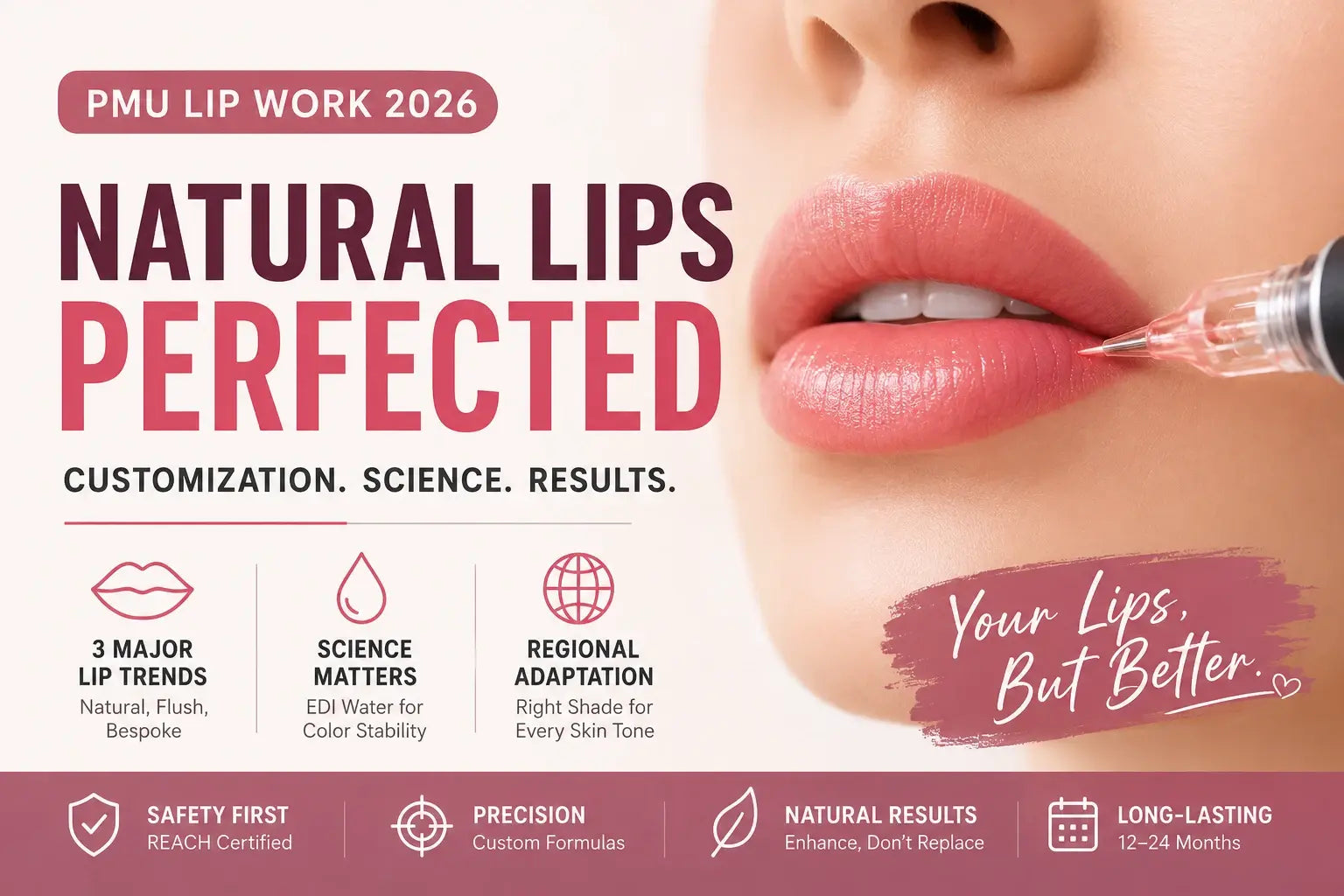
This article breaks down the three dominant 2026 lip trends, the science of why pigment solvent quality affects color stability, and the regional skin tone adaptation framework that separates professional lip work from amateur attempts at the natural look.
The Three Dominant Lip Trends of 2026
Trend 1: Natural Lip Blush — "Your Lips But Better"
The natural lip blush trend is the defining aesthetic of current lip PMU practice. Its core characteristic is low visual contrast — the goal is not to create a new lip color but to enhance the existing lip shade, adding fullness and healthy color without creating a defined lip line that says "tattoo."
The technical signature of natural lip blush is gradient application — color is concentrated in the center of the lip and softens toward the edges, creating the impression of natural lip coloration rather than a uniform coating of pigment. This requires:
- Lower pigment saturation than traditional lip work — the goal is 50–70% coverage, not full saturation
- A defined gradient from center to edge, which requires controlling pigment density per pass as the needle moves across the lip surface
- Preserving 1–2mm of natural lip edge showing through — no over-lining to create a fake lip boundary
Natural lip blush suits almost every client demographic but is particularly requested by professionals in client-facing roles who want a polished appearance without the "done" look that traditional lip PMU produces.
Trend 2: Flush Effect — The Healthy Color Boost
The flush effect adds a subtle healthy color boost to the natural lip, simulating the appearance of lips after exercise or light sun exposure — a natural, rosy flush that reads as healthy and vibrant rather than cosmetic. This trend sits between natural lip blush (which aims for understated enhancement) and traditional lip color (which aims for visible color change).
Technically, the flush effect requires slightly higher saturation than natural lip blush and relies heavily on pigment particle size and implantation depth — the goal is to achieve visible color without the color looking like it's sitting on top of the skin. Nano-scale pigments with precise depth control (0.5–0.7mm) are essential for this effect to read as natural rather than applied.
Trend 3: Bespoke Color — The Premium Tier
The most sophisticated trend in 2026 lip work is bespoke color — a fully customized color selection process that takes into account the client's genetic ethnicity, skin undertone, lip vascularity patterns, and personal aesthetic preferences to create a color formula that's unique to that client.
Bespoke color work is more time-intensive than standard lip PMU and commands significantly higher pricing. It's also where the professional differentiation in the market is clearest: any artist can apply pigment; the bespoke practitioner can analyze the client's facial structure, lip anatomy, color genetics, and lifestyle factors to construct a color plan that produces a result no other artist could replicate without that same analytical process.
The bespoke color trend is most common in major metropolitan markets and among clients with high aesthetic literacy who understand the difference between customized and standardized work.
The Science: Why Pigment Solvent Quality Determines Color Stability
What EDI Ultrapure Water Actually Changes in the Lip
The solvent in which pigment particles are suspended is frequently treated as an irrelevant carrier — the thinking goes, it's just the pigment particles that matter. This is incorrect. The solvent makes up the majority of the volume of any liquid pigment formulation, and its chemical purity directly affects how the pigment behaves after implantation.
Standard purified water used in budget pigment formulations contains trace metal ions, bacterial metabolites, and endotoxins — residual contamination from the water purification process. When this water carries pigment particles into the lip tissue, these impurities compete with the pigment molecules for binding sites in the dermal matrix. This competition has several negative effects:
- Oxidation reactions accelerated by metal ion contamination cause the color to darken and shift toward brown-grey over the weeks following the procedure
- Impurities trigger local inflammatory responses that affect how uniformly pigment integrates into the dermis, producing patchy retention patterns
- Clients with sensitive lip tissue may experience unexpected swelling or prolonged redness as the immune system responds to the impurity load
EDI (Electrodeionization) ultrapure water eliminates these contaminants by removing ionized particles through an electrochemical process rather than simple filtration. EDI water reaches resistivity of approximately 18.2 MΩ·cm and endotoxin levels below 0.25 EU/ml — standards that represent a qualitative difference from standard purified water, not just a marginal improvement.
For the artist, this means higher predictability in the healed color result. The pigment behaves in the lip tissue exactly as it behaves in the laboratory formulation, without unexpected reactions from contaminants. For the client, it means lower risk of post-procedure complications and a more stable final color.
Why REACH Certification Matters for Lip Work Specifically
REACH (Registration, Evaluation, Authorisation and Restriction of Chemicals) is the European Union's comprehensive chemical safety regulation. A pigment that carries REACH certification has had its complete formulation — including all ingredients, their concentrations, and all potential breakdown products — evaluated for skin sensitization, genotoxicity, and reproductive toxicity. This is a meaningful data point, not a bureaucratic checkbox.
For lip work, the sensitization and irritation data is particularly relevant because the lip tissue has higher exposure to external substances than any other PMU site — food, drink, kissing, dental products — and has significantly thinner barrier function than the skin elsewhere on the face. A pigment that passes REACH evaluation has documented safety data that covers this higher-exposure use case.
The practical implication for artists is straightforward: use REACH-certified or equivalent-regional-certification pigments for all lip work, and verify that the certification covers the specific formulation you're using, not just the brand's general product line.
The Four Soul Color Families and Their Regional Adaptation Logic
Color Family A: Coral Orange — Warm Skin Undertones
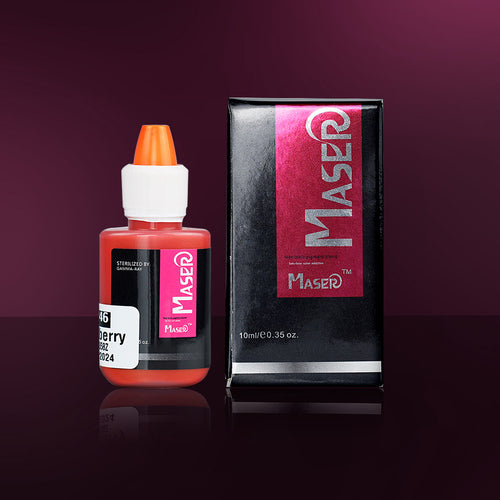
Coral orange-based pigments work by providing warm-toned color that complements rather than contrasts with warm skin undertones. The orange base counteracts the yellow component in warm skin, producing a natural balance that reads as "healthy natural lip color" rather than "applied color."
Regional adaptation of coral orange pigments:
- Southeast Asian complexions: Warm yellow base and medium depth — coral orange adds the pink-red undertone that balances without overwhelming the natural warmth. This is the most natural-looking option for this demographic.
- Latin American warm tones: Deeper skin with warm undertones — coral orange provides sufficient contrast without appearing ashy or too light, which would create an unnatural effect on deeper complexions.
- North American warm-toned clients: Often looking for subtlety and naturalness — coral orange works well when applied as a gradient from center to edge rather than as full-coverage uniform color.
Color Family B: Rose Pink — Cool Skin Undertones
Rose pink pigments are the adaptive solution for clients with cool skin undertones — the slight purple component in rose pink counteracts the cool grey-blue tendency in pale cool skin, producing a natural pink result. For cool-toned clients, using a warm-toned pigment (like coral orange) would create an orange cast that looks artificial on their skin.
Regional adaptation:
- Northern European clients: Light cool skin with low melanin — rose pink produces a natural flush that reads as healthy rather than cosmetic. The key is avoiding over-saturation, which makes the pink look "done" rather than natural.
- East Asian clients (Korean, Japanese): Often cool-neutral undertone — rose pink or a pink with very slight coral undertone works well, as the cultural aesthetic in these markets strongly favors this color direction.
- North American cool-toned clients: Rose pink works well for the "my lips but better" aesthetic when applied with soft gradient technique.
Color Family C: Cherry Blossom — The Light Pink Trend
Cherry blossom or soft pink tones represent the highest-saturation version of the natural look — they create a visibly noticeable color enhancement while maintaining the "nothing done" aesthetic through their lightness and softness. This trend is most popular with younger clients (18–30) and in markets with strong K-beauty influence.
Regional considerations:
- Light East Asian skin tones: Cherry blossom tones produce the "pure" aesthetic that aligns with regional beauty standards. The key is layering — building from a rose pink base and adding cherry blossom tone only to the center of the lip for a dimensional effect.
- Middle Eastern deep red complexions: Cherry blossom tones alone are generally too light and will appear ashy — they need to be mixed with deeper warm red tones to achieve the natural effect on deeper complexions. Pure cherry blossom application on dark skin tends to look obviously artificial.
Color Family D: Warm Apricot — The Universal Natural Tone
Warm apricot tones are the most versatile of the soul color families — they're warm enough to work on warm-toned skin, neutral enough to work on neutral skin, and the slight depth in the tone prevents the "pale lips" effect that very light tones can create on medium-to-deep skin. This makes warm apricot the recommended default for clients who are uncertain about their undertone or for artists building their initial color inventory.
Regional considerations:
- South Asian complexions: Warm apricot provides the natural balance effect on medium-to-deep warm skin that coral tones alone might make too light to achieve sufficient color impact.
- Middle Eastern deep red complexions: Warm apricot works as a base layer for coverage correction, providing enough depth to cover post-inflammatory hyperpigmentation or previous lip color that needs to be neutralized before applying the target color.
- Post-procedure correction: Warm apricot is frequently used as the base correction layer when covering lip colors that have shifted toward purple, grey, or blue — its warm depth provides a neutral platform on which the final color can be accurately built.
Regional Skin Tone Adaptation: Moving from "One Formula Fits All" to True Personalization
The ADS System: From Global to Regional to Individual
The concept of Area-based Dermal Shade (ADS) adaptation represents a maturation of how the PMU industry thinks about color selection. Rather than assuming that a single pigment formulation works equally well across all skin tones, the ADS framework builds color systems that have been specifically validated across the major ethnic and geographic population groups — European cool, North American warm, Southeast Asian neutral, Middle Eastern deep red, and South Asian warm deep.
This isn't just a marketing framework — it's a practical response to the fact that the same pigment formula applied to a light cool-toned European client and a deep warm-toned South Asian client will produce dramatically different visual results. ADS-based color systems provide the artist with formulations that have been tested in the relevant demographic contexts rather than being generic formulas with no ethnic validation data.
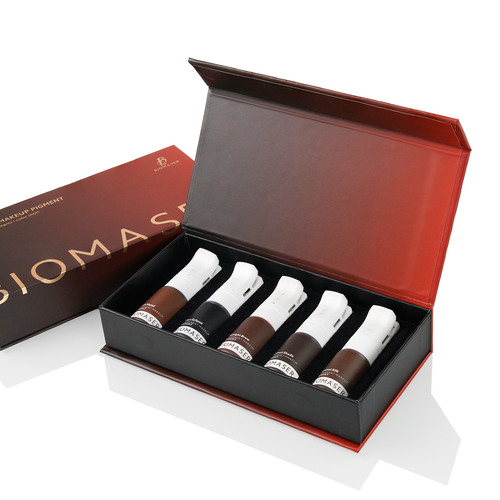
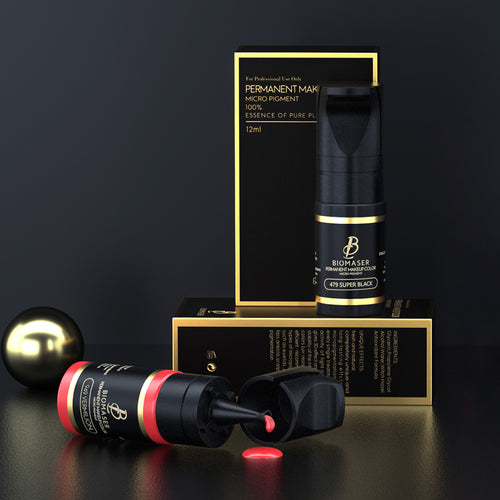
Brands like Biomaser have built their ADS framework over decades of market presence across 150+ countries, using the accumulated retention data from diverse ethnic skin types to calibrate their color formulations specifically for regional adaptation rather than assuming a single formula works globally. This is the kind of market-specific validation data that separates professional-grade pigment brands from generic commodity products.
FAQ
My client wants natural lip color but has very dark natural lips — is the natural look possible for her?
Absolutely — and it often produces some of the most beautiful results in PMU lip work. Dark natural lips respond very well to gradient application of warm apricot or warm coral tones, where the center of the lip receives higher saturation and the edges blend toward the natural lip color. The key is selecting a pigment with enough depth to be visible on the dark base without looking like a layer of lighter color sitting on top of it. An ADS-calibrated pigment system that has been validated on deeper complexions produces significantly more natural results than generic pigments selected for light skin.
Why does the immediate post-procedure color look great but the final result is darker than expected?
This is almost always caused by impurity-driven oxidation in the dermis. When the pigment solvent contains trace metal ions or endotoxins, these contaminants cause oxidation reactions in the skin that darken the pigment color during the healing window. Using EDI ultrapure water as the solvent eliminates these contaminants and produces significantly more predictable color behavior — the final result should be within a narrow range of the immediate post-procedure color rather than shifting significantly darker.
How do I maintain color stability after the procedure?
The critical window is the first 72 hours — during this period, avoid heat exposure (saunas, hot yoga, steamFacials), swimming in chlorinated pools, and intense physical activity that causes significant facial flushing. Heat and chemicals accelerate pigment oxidation, and intense flushing can push pigment particles laterally out of their intended dermal positions. After the initial healing window, standard sun protection and avoidance of retinoid products on the lip area will help maintain the result for its intended lifespan of 12–24 months.
Which color family should I start with when building a professional lip color inventory?
Warm apricot is the most versatile starting point — it works across warm, neutral, and medium-depth cool skin tones without the extreme specificity that rose pink (cool skin only) or coral orange (warm skin only) demand. Build your first four pigments around: warm apricot (universal base), rose pink (cool skin), coral orange (warm skin), and a deeper warm red (for correction and depth). This covers the majority of client needs and allows you to build experience with mixing before investing in more specialized formulations.
Key Takeaways
- The 2026 lip PMU market is defined by customization — natural lip blush, flush effect, and bespoke color represent three tiers of service that allow artists to serve different client segments with appropriately matched technical approaches
- Pigment solvent quality matters: EDI ultrapure water eliminates trace contaminants that cause unexpected oxidation, darkening, and patchy retention in lip PMU — the difference between predictable and unpredictable color behavior
- REACH certification provides documented safety data specifically relevant to the lip's higher exposure to external substances; verify the specific formulation is certified, not just the brand
- Regional skin tone adaptation moves from guesswork to system: warm apricot (universal base), coral orange (warm skin), rose pink (cool skin), and cherry blossom (light skin accent) form the four core color families, each with specific regional applications
- The ADS framework provides formulation validation across major ethnic groups — brands that have accumulated this data across diverse global markets offer meaningfully more predictable results than generic commodity pigments
- Natural-looking lip PMU is harder to achieve than high-saturation work — it requires more precise pigment selection, more controlled technique, and deeper understanding of how skin tone and lip vascularity affect the final resultBiomaser Tattoo
