






PMU Pigment Stability: The Triad of Particle Morphology, Solvent System, and Skin Compatibility

Introduction
Walk into any PMU discussion forum and you'll find the same complaints repeated: eyebrows that went blue within weeks, lips that faded to nothing in two months, eyeliner that spread into a grey smudge. In almost every case, the artist who performed the procedure is blamed — "wrong technique," "too deep," "inadequate aftercare."
But in a significant proportion of these cases, the problem originated in the pigment bottle, not in the procedure. A pigment formulation that isn't designed to remain stable in the dermal environment will produce unpredictable results regardless of how technically perfect the artist's hand was. The technician followed every correct protocol and still got a poor outcome because the pigment itself was compromised at the formulation level.
This is not a hypothetical concern — industry data suggests that approximately 40% of post-PMU complaints about retention and color behavior are attributable to pigment formulation issues rather than procedural technique. The challenge for professional artists is that you typically can't identify a bad pigment at the time of purchase. The formulation failure only becomes visible after the healing process is complete.
This article provides the analytical framework to evaluate pigment quality systematically — understanding the three factors that determine stability, how they interact, and what certification and quality control data points actually indicate about performance.
Factor 1: Particle Morphology — The Foundation of Retention
Why Particle Size Isn't Simple "Bigger vs. Smaller"
The most common simplification of pigment particle size is that "smaller particles = better penetration, larger particles = more permanent retention." This is partially true but significantly oversimplified. The actual retention behavior depends on the specific particle size range, the size distribution uniformity, and the particle geometry — not just the absolute size.
Pigment particles in the nano-scale range (0.020μm or approximately 20 nanometers) represent a meaningful performance threshold. At this size, particles are small enough to be phagocytosed by fibroblasts and integrated into the dermal matrix through the normal wound healing encapsulation process — the same process that creates stable long-term retention for any implanted material that the body doesn't recognize as aggressively foreign.
Larger particles above approximately 0.050μm begin to exceed the threshold that fibroblasts can efficiently encapsulate. These larger particles are more likely to be targeted by the immune system for lymphatic clearance or capillary absorption — both of which remove pigment from the target zone and cause the color migration effects that clients experience as "fading."
Particle Size Distribution: Why Uniformity Matters More Than Average Size
A pigment with an average particle size of 0.030μm but a wide size distribution (with particles ranging from 0.005μm to 0.150μm) will perform worse than a pigment with a tighter distribution centered at 0.035μm. The reason is the tail of the distribution: even a small proportion of oversized particles are enough to trigger immune clearance mechanisms that affect the entire deposit.
Uniform particle size distribution — achieved through precision milling and classification processes during pigment manufacturing — is the hallmark of professional-grade pigment formulations. Budget pigments often advertise average particle size without disclosing the distribution width, which is the more meaningful quality indicator.
The practical outcome for the artist: a pigment with tight particle size distribution produces more predictable retention, more consistent color behavior from session to session, and fewer unexpected tone shifts during the healing process.
Particle Geometry: Shape Affects How Pigment Sits in Tissue
The three-dimensional shape of pigment particles affects how they orient within the dermal matrix and how they're encapsulated by fibroblast cells. Angular, irregular particle shapes have a larger surface-area-to-volume ratio than spherical particles of the same volume — which means more surface area available for immune system recognition. Spherical or near-spherical particle geometries minimize this surface area and reduce the immune clearance signal.
Professional pigment manufacturers use precision milling processes that produce consistent particle geometry — not because spherical particles are inherently superior for every application, but because consistency in geometry produces consistency in tissue behavior. A batch of pigment where particles vary significantly in shape will produce variable retention outcomes even if the average size is correct.
Factor 2: Solvent System — The Protective Environment for Pigment Molecules
The Solvent Is Not Just a Carrier — It's an Active Formulation Component
A common misconception is that the solvent in pigment is simply the liquid that carries the solid pigment particles — functionally inert, like water in a solution. In professional PMU pigment formulations, the solvent is an active, critical component that determines how the pigment behaves from the moment it's deposited in the skin.
The solvent system performs three functions simultaneously:
- Chemical protection: The solvent surrounds and isolates pigment molecules, protecting them from external chemical exposures — sweat, sebum, sunscreen, skincare products — that can oxidize or degrade pigment molecules after implantation
- Delivery optimization: The solvent's surface tension and viscosity profile determine how the pigment flows through the needle and deposits in the tissue — formulations with poor solvent engineering produce inconsistent pigment release per puncture
- Skin compatibility support: The solvent's interaction with the dermal environment affects the initial inflammatory response, which in turn affects how evenly pigment integrates into the tissue matrix
What EDI Ultrapure Water Changes in the Solvent System
Many budget pigment formulations use standard purified water as the solvent base — purified through reverse osmosis or simple filtration, which removes most but not all ionic contaminants. Trace metal ions, bacterial metabolites, and endotoxins remain at low but nonzero concentrations. These residual contaminants are the source of several common pigment failure modes:
- Oxidation acceleration: Trace metal ions catalyze oxidation reactions in the pigment molecules when exposed to UV radiation or reactive skincare ingredients, causing the color to shift toward brown-grey over weeks and months
- Skin sensitization: Bacterial metabolites and endotoxins from inadequate water purification can trigger local inflammatory responses in sensitive clients, causing unexpected swelling, prolonged redness, or pigment rejection
- Inconsistent pigment performance: Variable residual contamination between batches produces batch-to-batch variation in how the pigment behaves in the skin — making it impossible for the artist to develop reliable technique parameters
EDI (Electrodeionization) ultrapure water achieves resistivity of approximately 18.2 MΩ·cm and endotoxin levels below 0.25 EU/ml — specifications that represent a qualitative distinction from standard purified water, not an incremental improvement. EDI water is produced by an electrochemical ion exchange process that removes virtually all ionized contaminants, leaving a chemically neutral solvent that doesn't introduce variables into the pigment's behavior in the skin.
Concentrated Formulations: What High-Concentration Solvent Systems Enable
Some professional pigment lines use concentrated solvent systems — higher pigment loading per unit volume of solvent. The practical advantages for the artist:
- More precise dosing: A single drop of high-concentration pigment delivers the same pigment load as multiple drops of standard formulation, reducing waste and improving distribution control
- Fewer passes for target saturation: Higher pigment loading per deposit means fewer needle passes are required to reach the target saturation level, reducing cumulative tissue trauma and procedure time
- Reduced lateral spread: When each deposit is more concentrated, the effective color per unit area is achieved with less total liquid volume introduced to the tissue — which means less lateral spread of pigment between deposit sites
These advantages are only realized when the solvent system is engineered to maintain pigment molecule stability at high concentration — which requires more sophisticated formulation science than standard diluted pigment products.
Factor 3: Skin Compatibility — The Bridge from Injection to Retention
The Retention Zone: Why Target Depth Determines Stability Duration
Pigment particles that reach the papillary dermis (0.5–0.8mm depth) are in the optimal retention zone. Fibroblast cells in this layer actively synthesize collagen and extracellular matrix, and the normal wound healing response creates a fibroblast encapsulation structure around foreign particles in this layer — this is the mechanism of stable PMU retention.
Pigment particles that migrate deeper — into the reticular dermis (0.8–2.0mm) or subcutaneous fat layer — encounter a different biological environment. The vascular density in these deeper layers is significantly higher, which means the immune system is more active and more likely to target pigment particles for clearance. This is the primary mechanism of blue-grey color migration in eyeliner and brow PMU: pigment placed too deep migrates toward the vascular layer, where hemoglobin and fat cell light-scattering produce the blue-grey cast.
Skin compatibility isn't just about the pigment chemistry — it's about how well the entire formulation (pigment plus solvent) supports accurate delivery to the target depth. A pigment with excellent dermal compatibility but delivered through a needle that consistently over-penetrates will still produce migration and fading problems.
Immune Response Modulation: The Third Component of Stability
The immune system's response to implanted pigment is the final determinant of how long the pigment remains stable. The ideal immune response is minimal — enough to trigger fibroblast encapsulation of the particles, but not enough to actively target and clear them through lymphatic or vascular pathways.
Pigment formulations that trigger aggressive immune responses (often indicated by prolonged redness, swelling, or heat at the treatment site in the days following the procedure) tend to produce inconsistent retention because the immune system is actively working to remove the pigment. Clients with hypersensitive immune responses may experience significantly faster pigment clearance than average.
The formulation characteristic that most affects immune response is the purity of the raw materials. Contaminants in the pigment — including residual metal ions from inadequate water purification, microbial metabolites, and unreacted chemical precursors — are the primary triggers of immune sensitization. This is why third-party testing certifications are more than bureaucratic documentation: they provide objective verification that the formulation has been tested for sensitization and irritation at the specific concentrations present in the final product.
The Three-Factor Interaction: Why All Three Must Be Simultaneously Optimized
The "Weakest Link" Principle in Pigment Formulation
Pigment stability is determined by the worst-performing of the three factors, not by the average. A pigment with perfect particle morphology and excellent skin compatibility will still produce poor retention if the solvent system allows rapid oxidation of the pigment molecules after implantation. A pigment with excellent solvent engineering and good particle morphology will still cause immune reactions if the skin compatibility is compromised by impurities. Each factor constrains the performance of the others.
This means that when evaluating pigment quality, all three factors must be assessed together — not just the particle size specification, or the certification badge, or the brand reputation. The only meaningful evaluation is the combined performance in actual use conditions.
Lock-Color Technology: An Example of Integrated Three-Factor Engineering
The "lock-color" technology found in some professional pigment lines is a marketing name for a specific integrated formulation approach where all three factors are engineered to work together:
- Particle morphology: Tightly controlled particle size distribution in the 0.020μm range, with near-spherical geometry to minimize immune recognition
- Solvent system: EDI ultrapure water base with concentrated formulation, providing chemical stability and precise dosing
- Skin compatibility: Formulated to minimize inflammatory response, with documented sensitization test data from independent laboratory testing
The practical result is that the pigment integrates into the dermal matrix cleanly, remains chemically stable over time, and produces the same color at12 months that it did at the time of the procedure — which is the actual definition of good retention, not just "it looks good when I do it."
Evaluating Pigment Quality: What the Certifications Actually Tell You
The Four Main Certification Standards
| Certification | What It Verifies | What It Doesn't Verify |
|---|---|---|
| EU CE Mark | Heavy metal limits, microbial limits, skin sensitization testing — meets EU safety thresholds for the specific formulation | Clinical performance or retention longevity; batch-to-batch consistency |
| US FDA Registration | Ingredient compliance, labeling accuracy, facility registration — confirms the product is legally marketed | Clinical performance or efficacy; formulation stability over time |
| German Dermatest | Human clinical skin compatibility testing — actual application on human skin under controlled conditions | Long-term retention or field performance; particle size consistency |
| SGS Third-Party Testing | Batch-level sampling and analysis — confirms each batch meets the formulation specifications | Clinical performance; only verifies the batch that was sampled |
No single certification is sufficient — what matters is the combination of multiple independent certifications covering different aspects of quality. A pigment with CE marking plus Dermatest clinical testing plus SGS batch verification has been evaluated across safety, clinical compatibility, and batch consistency — a much more meaningful quality signal than CE marking alone.
The Quality Control System Behind the Certifications
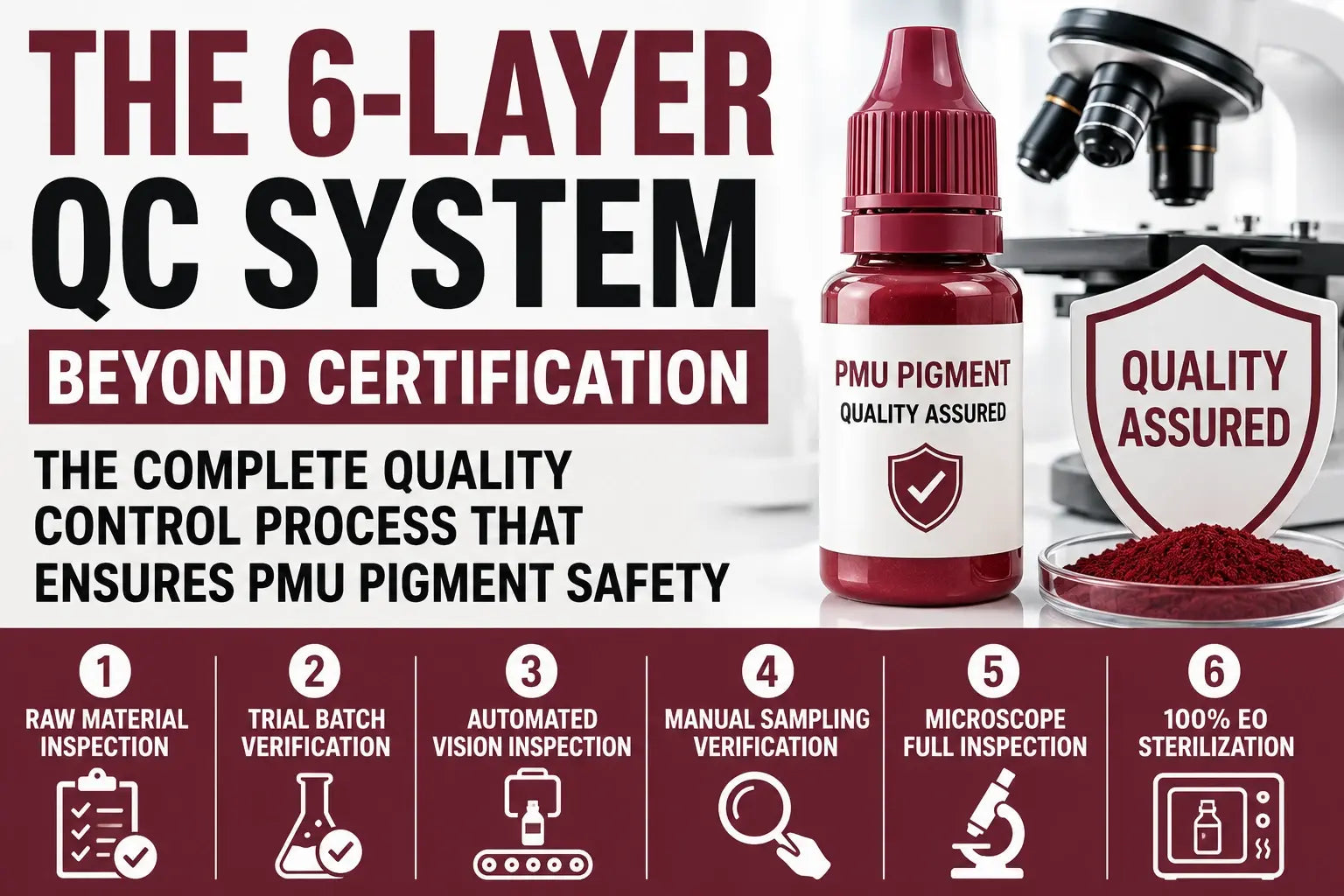
Certifications are the visible output of quality control systems that should be operating continuously in the background:
- Raw material particle analysis: Each batch of pigment raw material should be tested for particle size distribution and purity before use — not just the finished product
- Formulation stability testing: Accelerated aging tests (elevated temperature and humidity) that simulate months of storage in weeks, verifying that the formulation doesn't degrade during its shelf life
- Batch-to-batch consistency validation: Statistical sampling of finished product from each production batch to verify that particle size, concentration, and color consistency remain within specified ranges
When selecting a pigment brand, asking the supplier about their batch consistency data — not just whether they have certifications — provides a more direct measure of quality than the certification list alone.
Pigment Form Selection: Matching Form to Application and Skin Type
The Six Standard Pigment Forms
Professional PMU pigments are available in six standard physical forms, each with different viscosity and handling characteristics that make them suitable for different applications:
- Powder: Maximum precision and control — for experienced technicians who want the finest possible pigment particles and most controlled application. Requires careful dilution and mixing.
- Cream: Higher pigment loading per unit volume — for clients with normal to oily skin where additional coverage is beneficial. Good balance of saturation and control.
- Liquid: Fast application and smooth flow — for high-volume sessions where efficiency is important. Lower saturation per pass but faster coverage.
- Gel: High viscosity with good adhesion — for lip and eyeliner work where the pigment needs to stay in place during application without running or pooling.
- Oil-based: Deep penetration characteristics — for clients with dry or mature skin, or for deep correction work where maximum dermal integration is required.
- Concentrate: Maximum pigment loading in minimum volume — for specialized correction applications or for experienced technicians who want maximum control over dosing.
Matching the correct form to the client's skin type and the target procedure is a prerequisite for stable results — using the wrong form for a given skin type is a common cause of under-performance that's incorrectly attributed to the pigment brand rather than the form selection error.
FAQ
How can I tell if a pigment has good batch-to-batch consistency?
Ask the supplier for batch testing data — specifically, particle size distribution analysis and pigment concentration data from multiple different production batches. Reputable suppliers will have this data readily available. If the supplier can't provide it, that's a data transparency problem that suggests the quality control system isn't producing the documentation to back up consistency claims. You can also perform a simple consistency test yourself: apply the same amount of pigment from two different batches using the same technique on a test substrate and compare the color density and spread — significant differences indicate batch variability.
Why does my pigment look different color after it's been in storage for a few months?
This is oxidation — the pigment molecules are reacting with oxygen in the air inside the bottle over time. The solvent system's job is to slow this reaction, but all solvents have some gas permeability, and over months of storage, even well-formulated pigments will show some tone shift. To minimize this: store pigments in airtight containers, keep them away from direct sunlight and temperature fluctuations, and use the oldest bottles first (FIFO inventory management). If the tone shift in storage is severe or happens within weeks, the solvent system isn't providing adequate chemical protection — this is a formulation quality issue worth raising with the supplier.
My client's pigment seems to be fading faster than expected — how do I determine if it's the pigment or the technique?
The primary diagnostic indicator is the pattern of fading. Uniform fading (the entire treated area gets lighter at the same rate) is typically a formulation issue — the pigment particles are being metabolized or cleared faster than average. Patchy fading (some areas fade faster than others) is typically a technique issue — inconsistent depth or pressure caused some areas to receive pigment in the wrong dermal layer. If you're seeing consistent uniform fading across multiple clients using the same pigment, it's the pigment. If you're seeing patchy fading from one client but not others, it's more likely a technique variation worth reviewing.
Should I use the same pigment form for all skin types?
No — different skin types have different characteristics that benefit from different pigment forms. Oily skin tends to push pigment particles laterally during implantation, so a higher-viscosity form (cream or gel) with strong pigment loading per pass helps compensate. Dry or mature skin has less structural integrity in the dermis, so a less viscous form (liquid or oil-based) with moderate concentration allows for controlled penetration without excessive deposit volume. Matching form to skin type is one of the most controllable variables in optimizing retention — it's worth maintaining a small inventory of different forms to have the right tool for each client's skin type.
What certifications should I require from my pigment supplier?
At minimum: EU CE marking (to verify safety thresholds for the specific formulation, not just a general facility registration), and SGS or equivalent third-party batch testing to verify consistency. Ideally, add German Dermatest clinical testing data to the CE safety data, which gives you both clinical skin compatibility evidence and batch-level consistency assurance. US FDA registration is useful for confirming the supplier is operating in compliance with basic regulatory requirements but provides less clinical performance information than CE + Dermatest combined. Be cautious of pigments that carry only FDA registration without CE or independent clinical testing — that level of documentation is insufficient for evaluating long-term retention behavior.
Key Takeaways
- Pigment stability is a three-factor system: particle morphology, solvent system, and skin compatibility must all be simultaneously optimized — the weakest factor constrains overall performance
- Particle size uniformity (tight distribution) matters more than average particle size — a narrow size range in the 0.020μm range produces more predictable retention than a wide range centered at the same average
- EDI ultrapure water as a solvent base eliminates the residual contaminants that cause oxidation, sensitization, and batch-to-batch variability — this is a qualitative distinction, not an incremental improvement
- Skin compatibility is determined by both the formulation purity and the ability to deliver pigment to the correct dermal depth — a pigment that's chemically pure but delivered at the wrong depth will still fail
- Certification evaluation requires combining multiple standards: CE (safety), Dermatest (clinical compatibility), and SGS (batch consistency) together provide meaningful quality assurance; any single certification alone is insufficient
- Pigment form selection should match the client's skin type — oily skin benefits from higher viscosity forms, dry skin from lower viscosity, and maintaining a small inventory of different forms is a practical investment in retention optimization
