





Why Is Fake Skin Harder to Tattoo Than Real

Fake skin can feel harder to tattoo because synthetic material does not stretch, receive pigment, or respond to a needle like living tissue. If ink appears only after extra force or repeated passes, treat that as feedback about the practice surface—not as the pressure real skin will need. Keep your hand controlled, and change the material or setup instead of training yourself to push harder. Any move to human skin should happen through supervised professional training.
Synthetic material creates different resistance
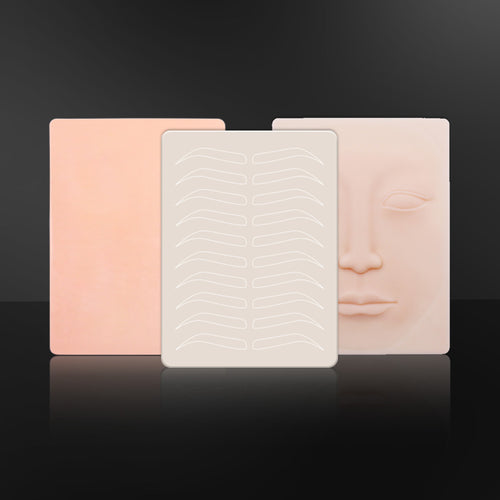
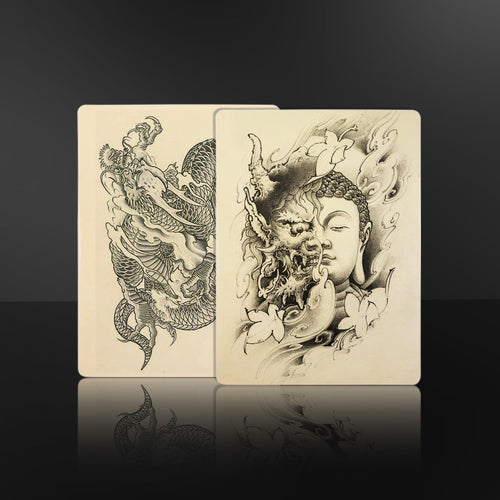
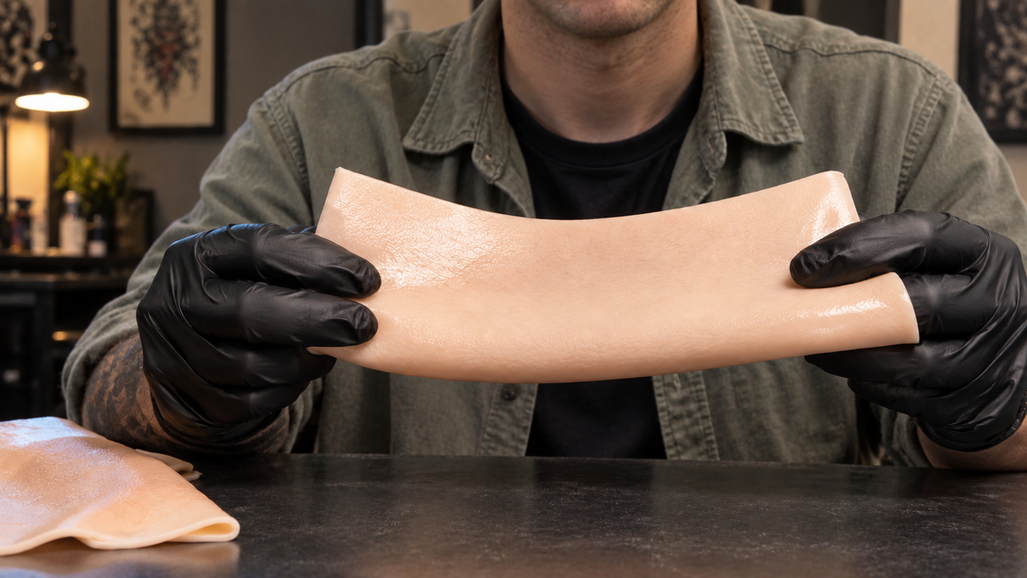
“Fake skin” covers products made with different silicone, rubber, or polymer formulas. Their density, thickness, surface finish, and elasticity can vary widely. A dense sheet may grip the needle or resist pigment, while a softer sheet may accept a mark with less effort. That is why two practice skins can feel different even with the same hand and machine setup.
Human skin is living tissue with a layered structure rather than a uniform synthetic sheet, as explained in this clinical overview of skin anatomy. Its resistance can also change with body location, skin tension, movement, and individual anatomy. It may accept pigment with less apparent effort than a firm practice sheet, but that does not make greater depth or repeated work an appropriate response.
The important comparison is not simply “fake skin is tougher.” Synthetic and living surfaces give different kinds of feedback. A uniform silicone sheet cannot reproduce swelling, bleeding, healing, discomfort, or the changing resistance of a real body area.
Extra effort on fake skin can teach the wrong pressure

Pressure is only one part of how a mark develops. Hand speed, needle movement, machine setup, surface tension, and the material itself all affect the result. When a resistant sheet produces a pale line, pressing harder may seem like the obvious correction. Repeating that response builds a heavy-handed habit.
That habit is unsafe to transfer to real skin. Tattooing breaches the skin, and recognized complications include infection and scarring; these risks are outlined in federal safety information about tattoos and permanent makeup. Fake skin also gives no pain response or biological warning that tells you to stop.
Consider an illustrative example: a learner wipes a line on a dense practice sheet and sees weak saturation. After two more forceful passes, the line looks solid, so the learner concludes that more pressure fixed it. The visible result does not prove that conclusion. The sheet may simply hold pigment differently, and carrying the same force and repetition to living skin could overwork it.
For practice on shaped permanent-makeup areas, the Biomaser 3D silicone practice skin can be used as a synthetic training surface for hand positioning on curved features. It cannot reproduce human skin resistance or biological response, and practice on it does not establish readiness to work on human skin.
Treat the effort required by fake skin as feedback about that material, not as a pressure target for living skin; pressure on a person should be learned through supervised professional training.
