
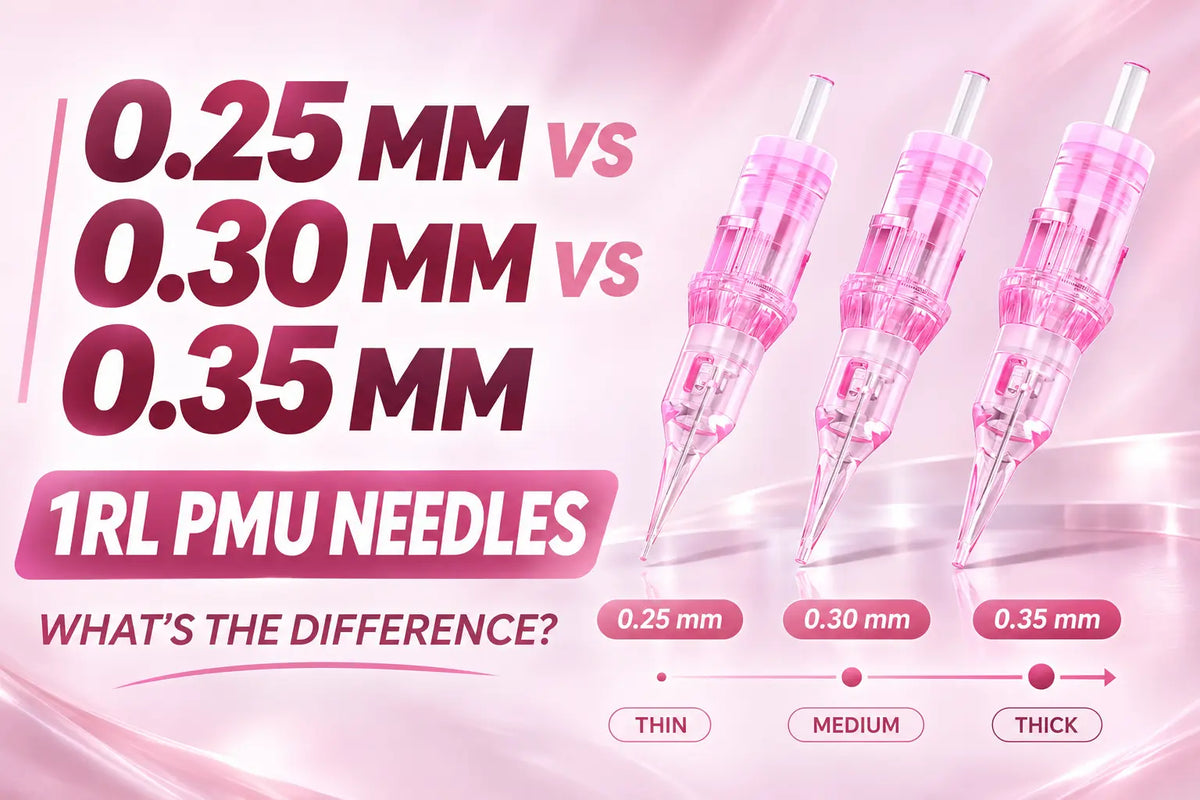
0.25 vs. 0.30 vs. 0.35 mm 1RL PMU Needles: How to Choose
Key Takeaways
- 0.25 mm needles offer a thinner shaft and greater flexibility.
- 0.30 mm provides a middle option for different linework needs.
- 0.35 mm has a thicker shaft and generally greater rigidity.
- Needle taper, cartridge design, and machine settings also affect performance.
- Choose a diameter based on your procedure, technique, and equipment.
PMU needle diameter can affect how a cartridge feels and performs during a procedure. Even when two cartridges use the same 1RL configuration, differences in shaft thickness can change their working characteristics.
The 0.25 mm, 0.30 mm, and 0.35 mm sizes are worth comparing for artists who perform eyebrow, lip, and eyeliner procedures. Each offers different characteristics, and understanding them can help artists make more informed purchasing decisions.
Understanding 1RL PMU Needle Sizes and Specifications
Start with the needle configuration, then look at diameter to see how the three sizes differ.
What Does 1RL Mean in PMU Needles?
1RL stands for Single Round Liner. It describes a cartridge with one needle arranged in a round liner configuration. Unlike 3RL or 5RL cartridges, which contain multiple needles, a 1RL uses a single needle for precise pigment application.
PMU artists commonly use round liner needles for:
- Individual eyebrow hair strokes.
- Nano brow detailing.
- Fine eyeliner work.
- Lip contouring.
- Small areas that require controlled line placement.
The number indicates the needle count, while RL describes the configuration. It does not refer to the needle diameter.
What Do 0.25 mm, 0.30 mm, and 0.35 mm Represent?
These measurements describe the thickness of the individual needle shaft.
| Needle Diameter | Common Gauge Reference | Relative Thickness |
|---|---|---|
| 0.25 mm | #08 | Thinnest |
| 0.30 mm | #10 | Medium |
| 0.35 mm | #12 | Thickest |
These gauge references are commonly used in the industry, but labeling can vary between manufacturers. Always check the specifications printed on the cartridge packaging.
Needle diameter also differs from the final width of a healed line. Taper, needle movement, pigment application, skin condition, and technique all contribute to the result.
Why Does Needle Diameter Matter?
Diameter affects the needle shaft's resistance to bending and its flexibility. A thinner shaft generally offers more flexibility, while a thicker shaft usually provides greater rigidity under similar construction conditions.
These differences can change the feedback an artist feels during a procedure. Diameter can also influence pigment-carrying characteristics, although it cannot predict the final pigment result on its own.


0.25 mm vs. 0.30 mm vs. 0.35 mm: Key Differences Compared
The three sizes have different physical characteristics and may suit different working preferences.
0.25 mm 1RL: For Fine Details and Delicate Linework
The 0.25 mm needle has the thinnest shaft in this comparison. Its relatively flexible structure makes it worth considering for artists who prioritize fine details and delicate line placement.
Potential applications include:
- Fine eyebrow hair strokes.
- Nano brow detailing.
- Delicate lip contours.
- Small eyeliner details.
A thinner needle can offer a fine working profile, but its flexibility also requires careful control. Its working feedback may differ from that of a thicker cartridge.
Artists should consider taper, machine settings, and hand movement rather than assuming that a smaller diameter automatically produces better results.
0.30 mm 1RL: A Middle Option for Versatile PMU Work
The 0.30 mm needle sits between the other two sizes. It provides a middle option for artists who want a combination of shaft flexibility and rigidity. Artists may consider this size for eyebrow detailing, hair stroke work, lip contours, and other line-based procedures.
Its range of potential uses makes it worth considering for artists who want to compare a medium diameter with finer or thicker options. Still, its performance depends on cartridge construction and working technique.
0.35 mm 1RL: For Greater Needle Rigidity
The 0.35 mm needle has the thickest shaft among the three options. Under similar construction conditions, its greater diameter generally provides more resistance to bending. Artists may consider it for selected procedures that call for a firmer needle structure and a different working feel.
It is important to avoid assuming that a thicker needle automatically creates wider lines or deposits more pigment. The final result also depends on taper, pigment properties, machine settings, and application technique.
Quick Comparison of the Three Needle Diameters
The table below provides a simple 1RL needle size comparison for artists who want to review the main differences at a glance.
| Comparison Factor | 0.25 mm | 0.30 mm | 0.35 mm |
|---|---|---|---|
| Shaft thickness | Thin | Medium | Thick |
| Relative rigidity | Lower | Moderate | Higher |
| Flexibility | Higher | Moderate | Lower |
| Main consideration | Fine details | Versatility | Greater rigidity |
| Potential applications | Fine linework | General linework | Selected defined linework |
These are relative comparisons, not performance guarantees. Different materials, needle lengths, and cartridge designs can change the working experience.
How Needle Diameter Affects PMU Performance
Physical differences become more useful when connected to actual PMU work. Several factors determine how a needle behaves during pigment application and how much control an artist has over each movement.
Needle Rigidity and Flexibility
Needle diameter affects resistance to bending. With the same material and construction, a 0.35 mm shaft generally has greater rigidity than a 0.25 mm shaft.
A thinner needle may feel more flexible, while a thicker needle may provide firmer feedback. These differences can affect how artists control their movements during detailed procedures.
Cartridge stabilization, needle length, and material quality also influence needle behavior. Artists should assess the complete cartridge design rather than judging performance from diameter alone.
Pigment Application and Line Definition
Needle diameter can influence how pigment is carried and applied. A wider shaft may have different pigment-carrying characteristics from a thinner shaft, but the amount of pigment entering the skin depends on several factors:
- Needle taper and tip geometry.
- Pigment viscosity.
- Cartridge tip design.
- Machine speed and stroke length.
- Hand movement and application technique.
A 0.35 mm needle does not guarantee darker results than a 0.25 mm needle. Likewise, a thinner needle does not automatically produce weaker pigment retention. The final appearance depends on the interaction between the cartridge, pigment, machine, skin, and artist's technique.
Skin Characteristics and Needle Selection
Thickness, elasticity, sensitivity, and previous procedures can affect how skin responds during PMU work. Artists should avoid selecting a diameter based only on skin type. Oily skin does not automatically require a 0.35 mm needle, and dry skin does not automatically call for a 0.25 mm needle. Professional assessment, suitable training, and controlled technique remain important for every procedure.

خراطيش إبر Biomaser Pinky Ultra للمكياج الدائم
How to Choose the Right 1RL Needle for Different PMU Procedures
After comparing the specifications and working characteristics, artists can narrow their options based on their services. Procedure requirements, experience, and equipment provide a more practical basis for selection.
Choose a Needle Diameter Based on Your Procedure
Different PMU procedures have different linework requirements.
- Eyebrow Hair Strokes: Consider 0.25 mm or 0.30 mm based on the desired stroke appearance and technique.
- Nano Brows: Evaluate finer needle configurations and their suitability for the artist's trained method.
- Lip Contour: Compare 0.30 mm and 0.35 mm according to the desired definition and cartridge design.
- Eyeliner Details: Prioritize precise control, suitable cartridge construction, and careful handling of the delicate working area.
These are starting points for professional evaluation, not fixed prescriptions. The artist's training and the client's skin condition should guide the final choice.
Consider Your Experience and Working Style
Artists with less experience may benefit from becoming familiar with a consistent needle setup through appropriate training and practice.
Experienced artists can compare different diameters to identify which cartridge characteristics suit their procedures and working preferences.
For a useful comparison, keep other variables as consistent as possible. Changing needle diameter, machine settings, and hand speed at the same time makes it difficult to identify which factor caused a change in performance.
Check Needle Taper Alongside Diameter
Needle taper describes the section where the shaft narrows toward its tip. Common designs include Short Taper, Medium Taper, and Long Taper.
Two cartridges with the same diameter can have different tip geometries and working characteristics because of their taper designs. For example, a 0.30 mm needle with a Short Taper may behave differently from a 0.30 mm needle with a Long Taper.
In a PMU needle taper vs. diameter comparison, diameter describes shaft thickness, while taper describes the narrowing section toward the point. Both are important when comparing cartridges.
Check PMU Machine and Cartridge Compatibility
Artists should check the connection type and manufacturer's compatibility information before purchasing. Machine settings also deserve attention. Stroke length, operating speed, and needle protrusion can influence working feedback and pigment application.
A compatible cartridge and suitable machine setup help artists maintain consistent equipment performance. Follow the manufacturer's operating recommendations and avoid making several setup changes at once.

خراطيش إبر الوشم Biomaser Pinky Pro 1R لرسم الخطوط الدائرية، لأقلام الوشم الدوّارة
BIOMASER 1RL PMU Needle Options for Different Diameter Preferences
Artists comparing round liner cartridge needles for PMU can also review product specifications from BIOMASER. Its product range includes configurations that correspond to the diameters discussed above.
BIOMASER x Carolina Alfonzo 1R Round Liner Cartridges
This product range lists three relevant configurations:
- 0801RL: 0.25 mm.
- 1001RL: 0.30 mm.
- 1201RL: 0.35 mm.
Having all three options within the same product range gives artists a direct way to compare specifications. Check the official product page for current variants, compatibility details, and availability.
BIOMASER Pinky Ultra PMU Needle Cartridges
The Pinky Ultra range offers 1R configurations in 0.25 mm and 0.30 mm. Its features include a stainless steel tip, an anti-backflow membrane, EO gas sterilization, and a silicone finger rest. Artists can review its specifications when comparing finer and medium round liner options.
Select the Best 1RL Needle for Your PMU Work
Choosing between 0.25 mm, 0.30 mm, and 0.35 mm comes down to the details of your work. Think about the lines you want to create, the cartridge you prefer, and the machine you use. Browse BIOMASER's 1R needles to compare available sizes and choose your next PMU cartridge.
FAQs About 1RL PMU Needles
Q1: Does a Smaller PMU Needle Diameter Cause Less Skin Trauma?
Not necessarily. A smaller diameter alone cannot guarantee less tissue trauma. Needle taper, sharpness, penetration control, working pressure, repeated passes, and application technique all influence skin response. Artists should follow professional training and use suitable equipment rather than relying on diameter alone.
Q2: What Needle Size Is Best for Machine Hairstrokes?
Artists may compare 0.25 mm and 0.30 mm configurations based on the desired stroke appearance, taper, cartridge design, and machine setup. Training and controlled practice should guide the final choice.
Q3: Can Different PMU Needle Brands Have Different Size Specifications?
Yes. Manufacturers may use different labeling systems, gauge references, and cartridge designs. Even when two products list the same nominal diameter, their taper, needle length, and housing may differ. Check the actual product specifications instead of relying only on the size code.
Q4: How Do You Know When to Replace a PMU Needle Cartridge?
Disposable PMU cartridges are designed for single use. Use a new, sterile cartridge for each client and procedure. Check the packaging and expiration information, and discard any cartridge with damaged or compromised sterile packaging. Dispose of used needles in an approved sharps container according to local regulations.
