






PMU Pigment Procurement Framework: Four-Dimensional Evaluation of Composition, Certification, Batch Stability, and Skin Adaptation

Introduction
Most PMU artists spend more time evaluating a new PMU device or needle than they spend evaluating a new pigment brand. This is a significant professional blind spot — the machine determines how precisely you can work, but the pigment determines whether your work looks correct six months later.
The common procurement approach looks like this: see a color that looks good in the bottle, check the price, order it. This is the procurement equivalent of choosing a surgeon based on the color of the scrubs. The color in the bottle is the least informative variable about what the pigment will do in the skin.
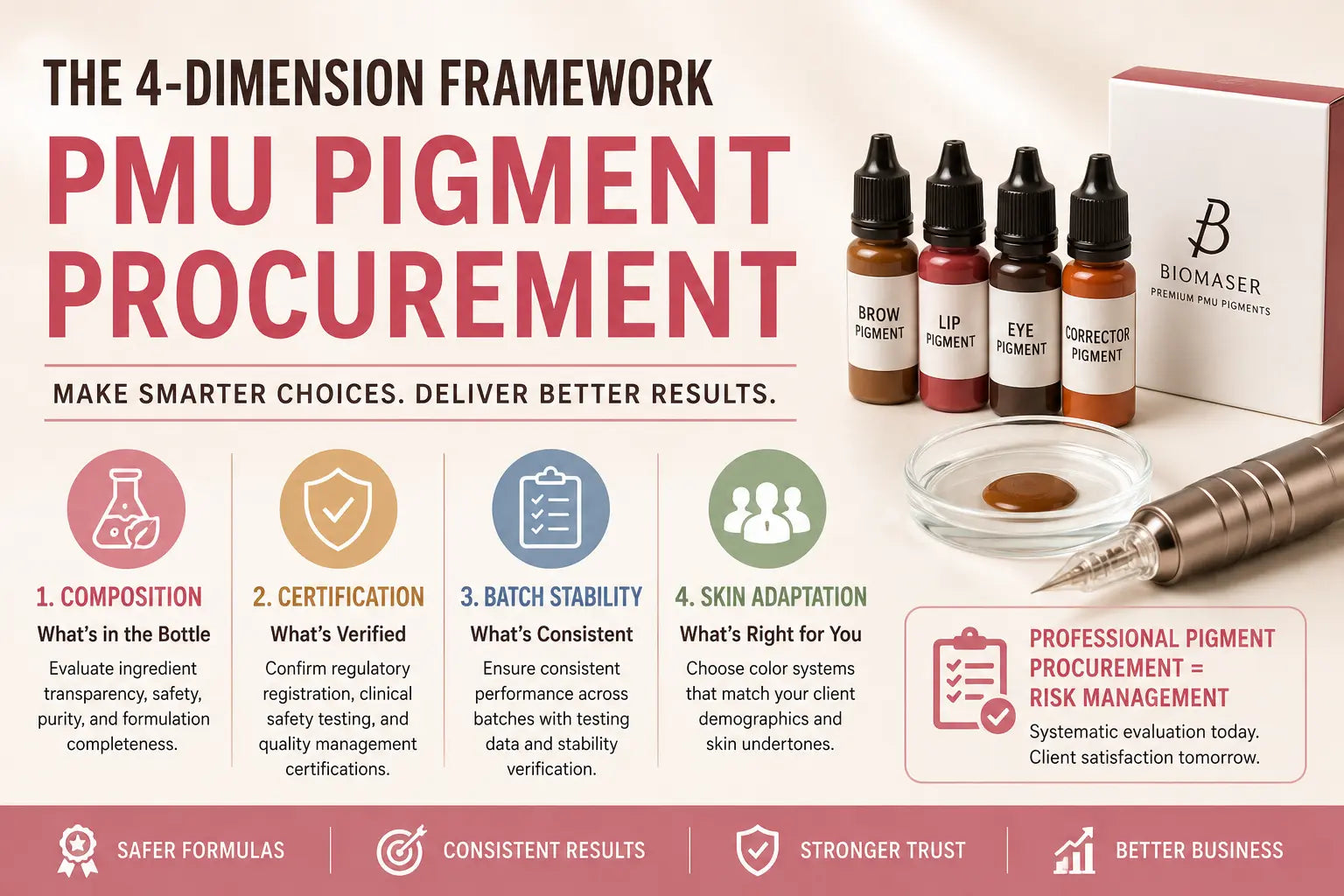
Professional pigment procurement follows a four-dimensional evaluation framework: composition (is this safe and effective?), certification (what does the verification evidence actually show?), batch stability (will the next bottle perform the same as this one?), and skin adaptation (does this line cover my client demographic?). This article explains each dimension and provides the specific evaluation actions you can take before committing to a supplier.
Dimension 1: Composition — The Foundation of What the Pigment Actually Does
Why "Ingredient Transparency" Is the First Procurement Criterion
The most basic question in pigment procurement is: what exactly is in this bottle? Not the color name, not the marketing description — the actual ingredient list and the third-party test data that confirms what's there.
Ingredient transparency matters for three reasons:
- Safety verification: Impurities and heavy metal residues in substandard raw materials can cause allergic reactions, pigment, or immune responses — even in formulations that look visually identical to professional alternatives
- Performance predictability: The pigment's behavior in the skin depends on the purity and consistency of the raw materials. Impurities don't just create safety risks — they create unpredictable color behavior, inconsistent retention, and unexpected tone shifts during healing
- Regulatory compliance: The specific regulatory requirements for PMU pigment vary by market — EU ResAP standards, US FDA requirements, Chinese NMPA regulations — and compliance requires that the formulation actually contains what the documentation says it contains
The evaluation action for composition: request the full ingredient declaration and the third-party heavy metal and microbial test reports for the specific products you're evaluating. A reputable supplier will provide these documents; a supplier that can't or won't provide them has already told you something important about their quality commitment.
What "Pure" Actually Means in Pigment Formulation
In the context of PMU pigments, "pure" means several specific things:
Pigment purity: Mineral oxide pigments must have specific purity grades — the iron oxide, titanium dioxide, or chromium oxide used must not contain undeclared other metal oxides as impurities. These hidden metals are the source of many unexpected skin reactions and color behavior anomalies.
Formulation completeness: Professional pigment formulations include not just the colorants but also appropriate stabilizers, moisturizers, and preservatives that maintain the product's physical stability after opening. A formulation that's just pigment powder mixed with water will change consistency after opening and may not remain sterile.
Source transparency: Knowing where the raw materials come from is part of quality transparency. Professional-grade manufacturers can tell you the general source region and supplier qualification for their key raw materials — not because they're required to, but because it's part of how they maintain quality control over their supply chain.
Natural Does Not Mean Safe — And Vice Versa
The "natural" and "mineral" marketing categories are frequently misunderstood in the PMU pigment context. Plant-derived pigments and mineral pigments each have their own characteristic impurity profiles, and neither category is inherently safer than the other.
What matters is not whether the pigment is "natural" or "synthetic," but whether it has been processed to remove impurities and tested for safety at the relevant concentrations. A professional-grade mineral pigment has undergone the same quality engineering as a professional-grade plant-derived pigment — the source is irrelevant to the safety profile, the processing is what determines it.
Dimension 2: Certification — What the Verification Evidence Actually Proves
The Three Levels of Certification Quality
Not all certifications carry the same weight. Understanding the difference between them is essential to making procurement decisions based on real evidence rather than marketing impressions.
Level 1 — Regulatory Registration (Baseline): FDA registration (US), CE marking (EU), and similar regulatory market access certifications. These confirm that the formulation has been reviewed against applicable regulations and that the manufacturer is operating as a registered facility. This is the minimum baseline — necessary but not sufficient for professional procurement decisions.
Level 2 — Product Safety Testing (Clinical): German Dermatest clinical skin compatibility testing, SGS third-party batch testing, and similar product-specific safety verification. These confirm that the specific formulation has been tested on actual human skin under controlled conditions, not just that the ingredient list meets regulatory thresholds.
Level 3 — Process Certification (System): ISO 9001 (quality management system) and ISO 13485 (medical device manufacturing quality management system). These confirm that the manufacturer has documented, auditable processes for controlling quality across every production batch — not just testing the final product.
A procurement evaluation that only confirms Level 1 certifications is incomplete. The combination of Level 1 plus Level 2 plus Level 3 provides meaningful quality assurance. Any single level in isolation is insufficient.
What FDA Registration Actually Confirms
US FDA registration for PMU pigments confirms:
- The formulation's ingredient list complies with FDA cosmetic regulations
- The manufacturing facility is registered with the FDA as a cosmetic manufacturing establishment
- The product label meets FDA labeling requirements
FDA registration does not confirm:
- Clinical performance or retention duration
- Batch-to-batch consistency
- The sterility of every individual bottle
- Formulation stability over the product's shelf life
For professional procurement, FDA registration is a necessary starting point — it confirms the brand is operating legally in the US market. But it must be combined with the other certification levels to become a meaningful quality signal.
ISO 13485: The Certification That Actually Changes Manufacturing Behavior
ISO 13485 is a quality management system standard designed specifically for medical device manufacturers. Obtaining this certification requires the manufacturer to implement:
- Validated production processes with documented process parameters
- Comprehensive batch traceability — every batch traced back to raw material lots and production records
- Documented corrective and preventive action (CAPA) procedures for handling quality deviations
- Regular internal audits and management review of the quality system
- Controlled production environment meeting medical device manufacturing cleanliness standards
The practical implication: a manufacturer with ISO 13485 certification is operating under a quality management discipline that is categorically more rigorous than standard cosmetic manufacturing. When you're evaluating pigment suppliers, ISO 13485 is the single most meaningful certification beyond the baseline regulatory registrations.
The Complete Four-Certification Matrix
For the most meaningful quality assurance, look for a supplier that holds all four certifications in combination:
- FDA Registration: US market regulatory compliance
- EU CE Marking: EU market regulatory compliance with ResAP safety standards
- ISO 9001: Quality management system — process control and documentation
- ISO 13485: Medical device manufacturing quality management
When all four are present, the supplier has built a quality management infrastructure that covers regulatory compliance, process control, and medical device grade manufacturing standards. This is the certification matrix that represents genuine quality commitment rather than regulatory minimum compliance.
Dimension 3: Batch Stability — The Variable That Determines Long-Term Client Satisfaction
Why Batch Stability Is the Hardest Dimension to Evaluate and the Most Important
Batch stability refers to the consistency of pigment performance across different production batches. A pigment brand that produces excellent results from one batch and inconsistent results from the next is a procurement liability — regardless of how good the first batch was.
The practical consequences of batch instability:
- Color deviation: The same pigment model from a different batch reads as a visibly different color — creating delivery inconsistency when the same artist uses the same color name on different occasions
- Consistency drift: Viscosity, spread characteristics, and penetration behavior change between batches — forcing the artist to constantly recalibrate their technique instead of developing reliable muscle memory
- Storage sensitivity: Unstable formulations undergo irreversible physical changes when exposed to temperature variations during shipping or storage — making the product unreliable before it's even opened
The root cause of batch instability is almost always in the production quality control system: imprecise raw material dosing, inadequate process parameter control during manufacturing, and insufficient finished goods testing. Brands with strong ISO 9001 and ISO 13485 certifications typically have the production controls that produce batch stability — because those standards require exactly the process documentation and validation that prevents batch variation.
How to Evaluate Batch Stability Before Committing to a Supplier
Three practical evaluation actions you can take:
1. Cross-batch sample comparison: Request samples from two to three different production batches of the same pigment model. Apply identical amounts using identical technique on a test substrate and compare the results. Look for color consistency, consistency similarity, and similar behavior during application. Significant differences between batches indicate inadequate production control.
2. Temperature stress testing: Store one sample in refrigeration (4°C) and another in an incubator (40°C) for 24 hours. Remove both and compare them against an unstressed control sample. Look for phase separation, viscosity change, or color shift in the stressed samples. A professionally formulated pigment should survive this test without irreversible change — a formulation that fails this test will behave unpredictably in real-world shipping conditions.
3. Small-batch trial before full commitment: Order a small initial quantity and use it in actual client procedures before committing to a large-volume purchase. This is the most direct evaluation method — actual use in your hands, on your clients, with your technique. If the initial batch performs reliably, you have evidence for full commitment. If it doesn't, you've limited your exposure to a small initial order.
What Batch Testing Documentation Should Look Like
Every batch from a professional manufacturer should come with batch-specific testing documentation — not just a general product specification sheet. The documentation should include:
- Microbial test results for the specific batch (total plate count, indicator organisms)
- Heavy metal screening results for the specific batch
- Color consistency data — ΔE value (color difference) from the standard reference, controlled to within the acceptable range
- Physical parameter data — viscosity, pH, specific gravity within specification range
If the supplier can only provide a general product specification sheet without batch-specific data, that indicates the quality system isn't producing batch-level documentation — which means the production QC isn't operating at the level that professional procurement requires.
Dimension 4: Skin Adaptation — Whether the Product Line Covers Your Actual Client Base
Why One Color Chart Cannot Serve All Client Demographics
The same pigment, applied to clients with different skin tones, will produce different visual results. This is not a quality defect — it's a physical fact about how pigment spectral profiles interact with different skin undertones. A warm coral pigment that reads as natural on a warm undertone client will look noticeably orange on a cool undertone client. A mid-tone brown that looks perfect on a light skin client will appear ashy on a deep skin client.
For a pigment line to serve a diverse client demographic, it needs sufficient color palette breadth and depth to handle the range of undertones and depths that the artist actually encounters. A line with only three to five colors will run into the "no right option" problem — where for some clients, none of the available colors produce a natural result.
The ADS Framework: What Professional Skin Adaptation Looks Like
The most professional pigment manufacturers have developed ADS (Area-based Dermal Shade) systems — systematic frameworks for matching pigment color families to specific regional demographic characteristics. This goes beyond simple "light/medium/deep" categorization to include:
- Undertone calibration: Cool, warm, and neutral undertone families within each color category — ensuring that regardless of which skin depth the client has, the undertone can be matched
- Regional demographic coverage: Different regional populations have characteristic undertone distributions — a brand with global distribution needs different color families for European cool-pink bases, Southeast Asian warm-neutral bases, and Middle Eastern deep warm-red bases
- Special population coverage: Specialized products for mature skin, oily skin, and other specific conditions that affect how pigment behaves in the skin
For professional artists serving diverse demographics, building a core pigment inventory around an ADS-calibrated system means having the right color available for every client — not having to choose the least wrong option from a limited palette.
The Minimum Viable Color Inventory for Professional Practice
Based on the four-dimensional framework, a professional PMU inventory should include:
- Brow colors: At minimum 6–8 colors covering cool/warm/neutral within the light/medium/deep range — enough to match across the full client demographic for both microblading and powder brow techniques
- Lip colors: At minimum 6–8 base colors covering the full undertone range plus 2 correction colors for neutralization work (essential for working on lips with purple, grey, or rose base colors)
- Eye colors: At minimum 3–4 colors spanning dark warm brown through warm black, with cool dark grey-brown options for cool undertone clients
- Correction colors: At minimum 2 neutralization colors — typically pearl white for violet/grey neutralization and a warm nude or yellow for warm correction work
Building this inventory doesn't mean purchasing all colors from one brand — it means having a systematic plan for coverage rather than accumulating colors opportunistically. A complete but well-chosen inventory typically runs 15–20 colors — and the return on investment in terms of client satisfaction and reduced correction procedures justifies the cost.
The Four-Question Procurement Evaluation Checklist
Before every pigment purchase decision, run through these four questions — not as a checklist where you need all "yes" answers, but as a systematic scan for the information gaps that represent procurement risk:
① Does the supplier provide full ingredient transparency and third-party test reports for the specific products I'm purchasing?
No → Procurement risk: you cannot verify safety or performance characteristics before use. Either require the documentation or choose a different supplier.
② What certifications does the supplier hold, and what is the scope of each certification (specific product vs. product line vs. entire facility)?
Only regulatory registration (FDA/CE alone) → Procurement risk: no process or batch consistency verification beyond the baseline. Look for ISO 9001 or ISO 13485 in addition to regulatory marks.
③ Can the supplier provide batch-specific testing documentation for the specific batches I would be ordering?
No → Procurement risk: the quality system isn't producing batch-level documentation, which means production QC may not be operating at professional standard. Request it or reconsider the supplier.
④ Does the product line's color coverage match my actual client demographic — across all undertones and depths I regularly encounter?
No → Procurement risk: you will encounter clients where none of the available colors produce acceptable results. Evaluate whether the gaps are critical enough to require a secondary supplier for specific color families.
FAQ
My current supplier has good colors but I'm not sure about their batch consistency — how do I evaluate this without risking client results?
Run the temperature stress test described in this article: one sample refrigerated at 4°C, one at 40°C for 24 hours, compared against an unstressed control. Then apply all three to test substrate with identical technique. If the stressed samples show visible color shift, viscosity change, or phase separation, the formulation's stability engineering is inadequate — which predicts batch-to-batch variation in real-world conditions. If they survive the test, request 2–3 different batch samples and run the cross-batch comparison. This gives you direct performance data without risking client results.
Is it worth paying more for a pigment brand with ISO 13485 certification when a cheaper brand has CE marking?
ISO 13485 and CE marking answer different questions. CE marking confirms the specific formulation passed safety testing for EU market access. ISO 13485 confirms the manufacturer has documented, auditable quality management processes covering every batch. These are not interchangeable — CE marking without ISO 13485 tells you the product was tested; ISO 13485 without CE tells you the process is controlled but doesn't confirm product safety testing for any specific market. The most meaningful combination is both together, plus FDA registration. If a brand has CE but not ISO 13485, the price difference for the ISO 13485 brand is a reasonable investment in procurement risk reduction — because batch consistency failures are expensive to fix in terms of client relationships and correction procedures.
I serve mostly clients with medium to deep skin tones — how do I know if a pigment line is adequate for this demographic?
Evaluate the color line's depth coverage first. For medium to deep skin tones, you need colors specifically calibrated for warm undertone and deep depth interactions — which means the brand needs to have specifically developed and tested colors for this demographic, not just a general "dark" category that doesn't account for undertone differences. Check whether the brand has an ADS regional framework that includes warm undertone deep skin calibration. Also evaluate whether the brow colors have warm undertone families (golden browns, warm chocolates, auburn tones) and whether the lip colors have warm coral and deep warm red options. If the brand's palette doesn't have specifically warm undertone families for deep tones, the coverage for your demographic is incomplete.
How many colors should I maintain in my professional inventory for brow work?
A professional brow inventory needs at minimum six to eight colors to handle the full range of skin tones and undertones reliably. The minimum viable coverage: two cool tones (one light-medium, one medium-dark), two warm tones (one light-medium, one medium-dark), one neutral tone for each depth category, and optionally one darker shade for depth contrast. If you work across multiple brow techniques (microblading + powder brows), you may want additional colors for technique-specific optimization. Start with the minimum six to eight and add based on the specific gaps you encounter with real clients — this is more cost-effective than building a large inventory that includes colors you never use.
Can I use the same pigment brand for lips and brows, or do I need specialized product lines?
Lip-specific and brow-specific formulations are optimized for the different physiological environments of each zone. Lips have much thinner skin, higher vascularity, and more acidic conditions than brow skin — a formulation optimized for lip work will have different viscosity, pH, and ingredient specifications than a brow formulation. Some professional brands make zone-specific products; others make multi-zone formulations that work adequately across zones but may not be optimized for any single zone. If you do significant lip work, using a lip-specialized product line is worth the inventory investment — the safety profile and color performance are specifically engineered for the lip's physiological characteristics in a way that general-purpose formulations are not.
Key Takeaways
- Pigment procurement is a risk management discipline, not a color preference selection process — the four-dimensional framework exists because the variables that determine client satisfaction are not the same as the variables that determine purchase satisfaction
- Ingredient transparency (Dimension 1) is the non-negotiable starting point — if you can't verify what's in the bottle through third-party test data, you cannot verify safety or performance regardless of price or brand reputation
- Certification evaluation (Dimension 2) requires understanding what each certification level actually confirms — regulatory registration (FDA/CE) is necessary but insufficient; add ISO 9001 for process control and ISO 13485 for medical device grade manufacturing standards
- Batch stability (Dimension 3) is the hardest dimension to evaluate pre-purchase but the most important for long-term client satisfaction — use cross-batch sample comparison and temperature stress testing as practical evaluation tools
- Skin adaptation (Dimension 4) determines whether the product line actually serves your client demographic — a color chart that looks good in the studio will produce wrong results on clients outside the brand's calibrated demographic range
- The four-question procurement checklist (ingredient transparency, certification scope, batch documentation, demographic coverage) should be run for every purchase decision, not just for new supplier evaluation
